
If you’ve ever heard someone say “We need a learning journey for this course” when they actually meant a learning path, let's just sort it out.
In fact, L&D teams, HR managers, and even experienced instructional designers often mix up these two terms. And honestly, it’s not their fault.
Both sound similar.
Both involve guiding learners from Point A to Point B.
Both help employees grow.
So… why does the difference matter?
Because “Learning Path” and “Learning Journey” are not just different words.
They represent two completely different approaches to employee development, and choosing the wrong one can impact engagement, skill growth, and training outcomes.
In the sections ahead, we’ll break down these two concepts in the simplest, clearest way possible, so you’ll never confuse them again.
Learning Path vs. Learning Journey
Let’s do a quick thought exercise:
Imagine you want employees to complete a structured set of courses to master a new tool.
This needs a Learning Path.
Now imagine you’re developing future leaders with coaching, projects, workshops, and reflection activities.
This needs a Learning Journey.
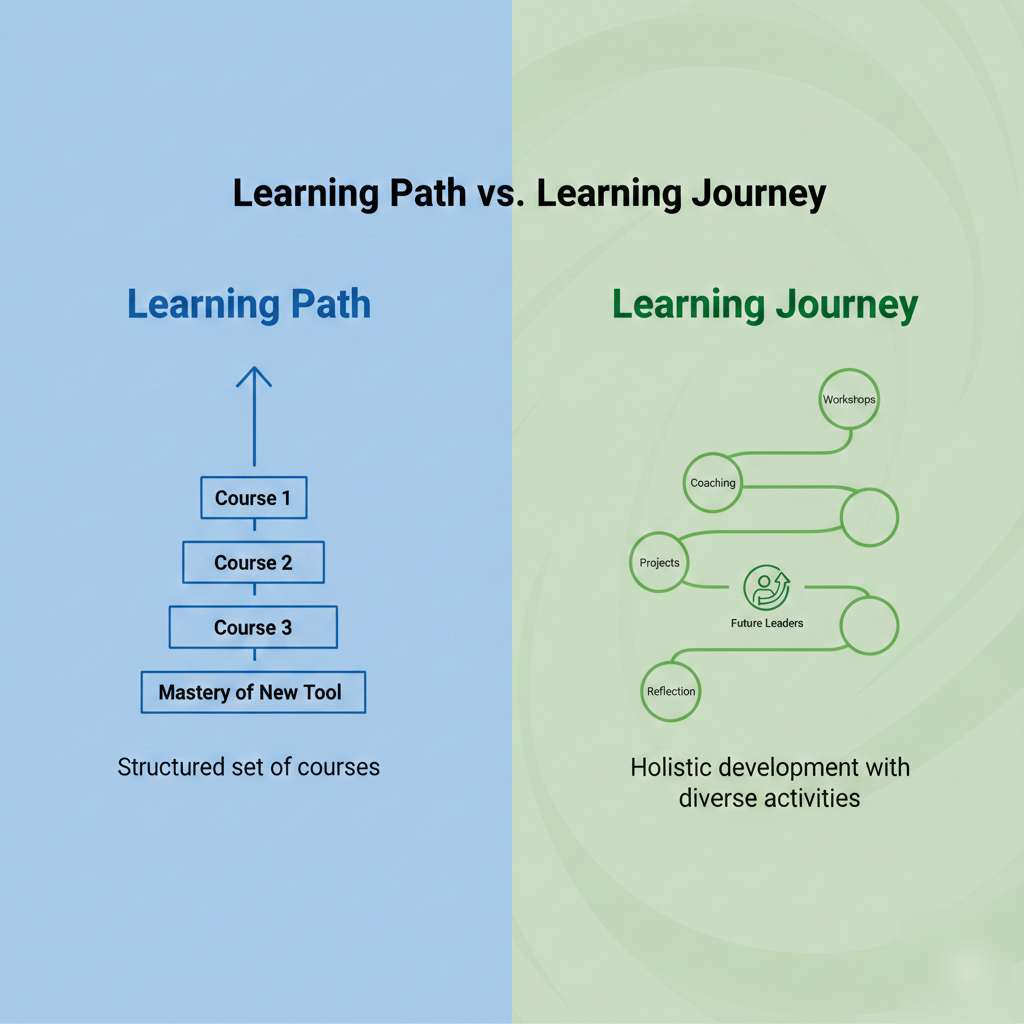
See the difference already?
Understanding which approach to use helps L&D and HR teams:
- design more effective training programs,
- improve learner motivation,
- align training to skill or behavior goals, and
- deliver learning experiences that actually stick.
What Are Learning Paths?
Let’s start with the simplest way to imagine a learning path:
Think of it as a GPS for skill development.
It tells learners exactly where to start, where to go next, and how to reach the final destination, with no detours, no confusion, no missed steps.
A Learning Path is a structured, step-by-step sequence of courses, lessons, or activities that guides learners toward mastering a specific skill or becoming job-ready for a particular role.
It’s designed to answer one important question:
“What should the learner do first, second, and third to build this skill effectively?”
Why Learning Paths Work So Well
Learning paths are linear for a reason.
Each step prepares the foundation for the next.
It’s like stacking building blocks, skip one, and the whole structure becomes shaky.
Here’s what makes them powerful:
Structured & Sequential
Learners follow a clear order:
Module 1 → Module 2 → Assessment → Final Certification.
There’s no guessing. No choosing randomly.
Everything is intentional and connected.
Competency-Based
Learning paths aren’t just about “finishing courses.”
They’re about building skills, measurable, job-aligned skills.
Each step is designed to help the learner:
- understand,
- practice,
- apply,
- and master a competency.
Ideal for Skill & Role Progression
Learning paths shine when the goal is progression.
Perfect for:
- becoming a certified sales rep
- upskilling to a senior developer
- understanding company policies
- mastering a tool or process
- moving from beginner → intermediate → advanced
If you want learners to grow in a structured, predictable, job-ready way, a Learning Path is the right tool.
What Are Learning Journeys?
If a learning path is a GPS, then a Learning Journey is more like a travel experience.
You’re not just moving from Point A to Point B; you’re exploring, reflecting, practicing, learning from others, and discovering new insights along the way.
A Learning Journey is a holistic, multi-touch learning experience designed to create long-term growth, behavioral change, and deeper understanding.
It’s not strictly linear. And it’s not limited to courses.
Instead, it blends formal, social, and experiential learning into one continuous development experience.
Think of it this way:
A learning path builds skills.
A learning journey builds people.
Why Learning Journeys Feel Different
Unlike paths, learning journeys stretch beyond modules and assessments.
They involve real-world thinking, collaboration, and practice, which is why they’re perfect for leadership, culture, and high-impact programs.
Flexible & Non-Linear
Learners don’t have to follow a rigid order.
They move through activities at their own rhythm, like workshops, coaching calls, reflections, group discussions, real projects, etc.
It’s about growth, not just completion.
Experience-Based, Not Just Course-Based
A learning journey might include:
- self-paced courses
- interactive workshops
- instructor-led sessions
- mentoring or coaching
- peer learning circles
- real-world assignments
- reflections & journaling
- feedback loops
Each touchpoint adds depth and insight.
Designed for Big Shifts, Not Just Skills
Journeys are perfect when your goal is to:
- build future leaders
- shift mindsets
- support career development
- improve soft skills
- drive cultural or behavioral transformation
They help learners think differently, not just learn something new.
A Learning Journey isn’t just training; it’s a growth experience.
It’s immersive, reflective, collaborative, and designed for long-term impact.
When you want learners to evolve, not just complete tasks, a Learning Journey is the right approach.
Key Differences: Learning Paths vs. Learning Journeys
| Aspect | Learning Paths | Learning Journeys |
|---|---|---|
| 🎯 Structure | 🟦 Linear & Step-by-Step (Step 1 → Step 2 → Step 3) | 🟧 Flexible & Non-Linear multiple routes & experiences |
| 🎓 Purpose | 🟦 Skill-Building & Competency Mastery | 🟧 Growth, Mindset Shift & Transformation |
| ⏱️ Duration | 🟦 Short–Mid Term (hours to weeks) | 🟧 Long-Term (months or years) |
| 📚 Learning Style | 🟦 Course-Based & Structured | 🟧 Experience-Based & Holistic |
| 🧩 Activities | 🟦 Courses, quizzes, modules, certifications | 🟧 Workshops, coaching, peer circles, projects, reflection |
| 📈 Measurement | 🟦 Easy Tracking: completion % and scores | 🟧 Growth Tracking: behavior, confidence, application |
| 🧭 Best For | 🟦 Onboarding, compliance, technical training, certifications | 🟧 Leadership, soft skills, culture programs, career growth |
| 🧠 Learning Experience | 🟦 Predictable & structured | 🟧 Immersive, multi-touch & continuous |
| 🗺️ Learner Autonomy | 🟦 Low–Medium: follow the route | 🟧 High: choose paths, explore experiences |
| 🏁 Outcome Focus | 🟦 Skill Mastery | 🟧 People Development |
When Should You Use Learning Paths?
Choose a Learning Path when your goal is to:
- Develop specific knowledge or skills
- Ensure consistency across teams
- Certify employees
- Meet regulatory requirements
- Reduce onboarding time
Paths are perfect for scalable, repeatable training.
When Should You Use Learning Journeys?
Choose a Learning Journey when your goal is to:
- Transform behaviors
- Build leaders
- Support long-term career development
- Encourage reflection and collaboration
- Blend formal + social + experiential learning
Journeys help employees grow in a more meaningful, human way.
How BrainCert LMS Supports Both Learning Paths & Learning Journeys
One of the biggest challenges for L&D teams is finding an LMS that can support both structured, step-by-step learning and flexible, experience-rich development programs.
The good news?
BrainCert is built for both.
It gives you the structure you need for Learning Paths and the flexibility you need for Learning Journeys, inside one powerful platform.
Let’s break down how.

1. Build Structured, Sequential Learning Paths with Ease
BrainCert makes creating learning paths incredibly simple, even if you’re new to L&D or course design.
Drag-and-Drop Path Builder
Create ordered sequences of modules, lessons, quizzes, and certifications.
Enforce Prerequisites
Ensure learners complete each step in the correct order.
Role-Based Paths
Assign paths to job roles like:
- Sales reps
- Support teams
- HR
- Engineers
Perfect for skill development, onboarding, and compliance.
Completion Tracking & Reporting
See exactly where learners are progressing, and where they’re stuck.
BrainCert gives you the structure, clarity, and control needed for true competency-based learning.
2. Create Flexible & Immersive Learning Journeys
Learning journeys often require multiple touchpoints, and BrainCert delivers the perfect ecosystem for that.
Mix Multiple Learning Formats
Combine:
- self-paced courses
- live classes
- webinars
- workshops
- discussion forums
- assignments
- real-world projects
- coaching or instructor-led sessions
You can design journeys that truly feel like a development experience, not just a list of modules.
Build Multi-Stage Programs
Create journeys that unfold over weeks or months, with checkpoints, milestones, and activities spread out over time.
Support Reflection & Collaboration
Use features like:
- discussion boards
- social learning
- peer feedback
- community groups
Perfect for leadership, soft skills, and culture-building journeys.
Personalized Learning Paths Inside Journeys
AI-powered recommendations help learners choose which topics, skills, or resources they explore next.
This makes BrainCert suitable for deeper, human-centered learning experiences.
3. Unified Analytics for Both Paths & Journeys
Whether learning is structured or flexible, BrainCert gives you a clear view of:
- skill mastery
- engagement
- progress
- assessments
- behavior over time
- completion milestones
- activity patterns
You get both quantitative data (scores, modules, time spent) and qualitative insights (discussion activity, peer engagement).
4. Scales Easily for Any Size Team
Whether you’re training:
- 50 employees
- 500 learners
- 5,000 customers
BrainCert allows you to build, deliver, and manage both learning paths and journeys at scale, without complexity.
5. A Single Platform for Every Learning Need
Most organizations end up using different tools for structured training vs. experiential programs.
With BrainCert, you don't need to juggle multiple systems.
Everything happens in one place:
✔ courses
✔ live sessions
✔ communities
✔ assessments
✔ certifications
✔ journeys
✔ paths
✔ analytics
This creates a seamless experience for both learners and admins.
Learning Paths need structure.
Learning Journeys need flexibility.
BrainCert gives you both.
It empowers L&D, HR, and training teams to design learning that builds skills and transforms people, no trade-offs required.
Conclusion
Learning Paths and Learning Journeys may sound similar, but they serve very different purposes in employee development. The most effective L&D strategies don’t choose between the two; they use both, depending on the goal.
When you pair the precision of a Learning Path with the depth of a Learning Journey, you create a training ecosystem where employees don’t just complete lessons…
they grow, evolve, and perform at a whole new level.