
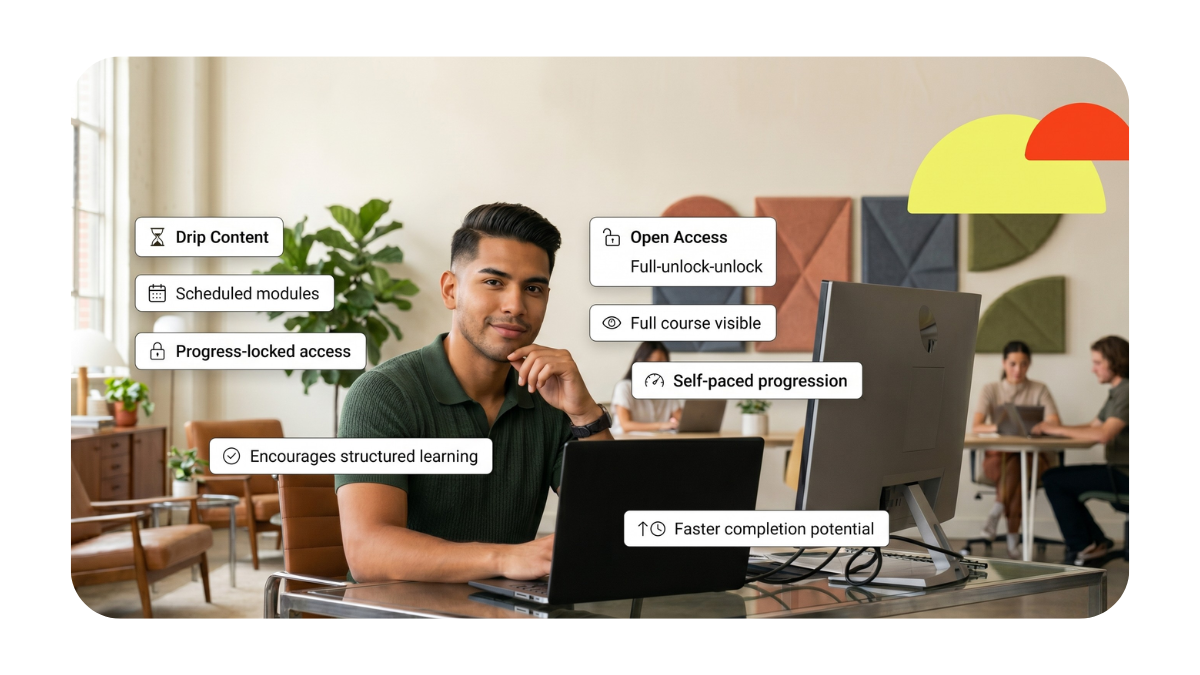
When it comes to delivering online courses, how you release your content can be just as important as what you teach.
Should learners get everything at once?
Or should content be released gradually over time?
This is where the debate between drip content and open access comes in.
If you’re a course creator, educator, or training organization, choosing the right model can directly impact engagement, completion rates, and learner satisfaction.
Neither is universally "better." But one will work better for you.
What Does Drip Feed Content Mean?
The term "drip content" comes from the idea of water dripping, slow, steady, deliberate. In e-learning, drip content refers to a delivery method where course material is released to students incrementally over time, rather than all at once.
Think of it like a schedule.
Instead of getting access to 40 lessons the moment they enroll, a student might unlock:
- Week 1 — Foundational modules: "Setting the Stage"
- Week 2 — Intermediate skills, unlocked after Day 7
- Week 3 — Advanced lessons, released on Day 14
- Week 4 — Capstone & certification materials
The goal is not to restrict access arbitrarily; it's to pace the learner's journey so they absorb and apply each section before advancing to the next.
Drip content is not about withholding value. It's about pacing it. Properly scheduled content prevents overwhelm, creates learning momentum, and gives students a reason to return regularly.
What Is Drip Course Content?
Drip course content is the structured, time-gated release of individual lessons, modules, quizzes, or assignments within a course. Releases can be triggered in three main ways:
1. Calendar-based scheduling Content unlocks on a specific date for all enrolled students, regardless of when they signed up. Ideal for cohort-based programs with a defined start date.
2. Enrollment-relative scheduling Content unlocks X days after each student's individual enrollment date. If Student A enrolls on the 1st and Student B on the 15th, they both progress through the same journey at their own pace.
3. Completion-based sequencing Students must finish one module, or pass a quiz, before the next becomes visible. This ensures prerequisite knowledge is in place before advancing.
Each of these drip methods serves a different use case, and some platforms (like BrainCert) let you combine them within the same course.
What Is Open Access Delivery?
Open access, sometimes called "all-at-once" delivery, is the opposite approach. When students enroll, every lesson, module, and resource is immediately available. They can binge through it like a Netflix series, skip around, or focus only on what's relevant to them right now.
This model is common on platforms like Udemy and Coursera's self-paced tracks. It prioritises autonomy and flexibility, letting learners chart their own path through the material.
Open access works best when:
- Students have prior knowledge and don't need a linear path
- The course functions as a reference library (software tutorials, tool documentation)
- Learners have unpredictable or irregular schedules
- The content is short and easily consumed in one sitting
Head-to-Head Comparison
Pros and Cons
| Drip Content | Open Access | |
|---|---|---|
| Completion rates | Higher — structure builds habit | Lower — "I'll finish it later" |
| Learner autonomy | Lower — time-gated progression | Higher — full freedom |
| Refund risk | Lower — value delivered over time | Higher — can binge and refund |
| Community/cohort support | Excellent — everyone progresses together | Poor — no shared rhythm |
| Best for beginners | Yes — prevents overwhelm | No — can be overwhelming |
| Best for advanced learners | Sometimes frustrating | Preferred — they can skip ahead |
| Upfront planning required | Higher | Lower |
| Perceived value | Higher — feels premium and structured | Lower — can feel like a data dump |
Who Does Each Model Serve Best
Choose drip content if you're building:
- A skill-development course (coding, writing, design, fitness)
- A coaching or mentorship program with weekly check-ins
- A cohort-based learning community
- A certification or compliance training programme
- A membership site with ongoing monthly content
Choose open access if you're building:
- A software tutorial or tool walkthrough
- A short mini-course (under 2 hours total)
- A reference library for professionals
- A course where learners have varying levels of prior knowledge
- A B2B training product used across teams with different schedules
Revenue and Business Model Impact
Drip content naturally supports subscription and recurring revenue models. When your best content arrives over weeks or months, students have a reason to stay subscribed.
Open access works well for one-time payment models and high-volume, lower-price sales. It's easier to market ("get everything instantly") and suits impulsive purchase decisions. However, higher refund rates are a common challenge.
Which Model Works Best for Your Course?
Use this quick guide to find your fit:
Your course is a skill-building programme → Choose drip content. Skill development requires building on prior knowledge. Week-by-week release ensures students practice before advancing, resulting in better mastery and completion rates.
Your course is a reference or tool tutorial → Choose open access. Reference courses are consulted non-linearly. Users jump to the exact lesson they need. Gating this content creates frustration rather than learning value.
Your course is a coaching programme → Choose drip content. Coaching follows a structured journey. Weekly content drops align perfectly with coaching calls, assignments, and accountability check-ins.
Your course is certification training → Choose drip content with completion gates. Sequential, verified learning is essential for credibility. Ensure each module is completed before the next one unlocks.
Your course is a short mini-course → Choose open access. Short courses (under 2 hours total) work best with full access. The content is consumed quickly, and students feel immediate ROI.
Your course is a membership community → Choose drip content. Monthly content releases are the backbone of successful memberships. They give members a reason to stay subscribed and return each month.
What About a Hybrid Approach?
Many successful course creators combine both models within a single course:
- Module 1 (open access): Available immediately on enrollment to deliver instant value and reduce hesitation
- Modules 2–8 (drip): Released weekly to build habit and ensure structured learning
This approach reduces pre-purchase hesitation (students can "try before they buy" at the start) while still maintaining the learning structure that drives completion.
How BrainCert Makes Drip Scheduling Effortless
Not all platforms handle drip content equally. BrainCert's drip-feed scheduling feature is built directly into the course builder, no workarounds, no third-party automations required.
What BrainCert's drip scheduling offers:
- Enrollment-relative scheduling — Unlock content X days after each student's individual enrollment date
- Fixed calendar dates — Release content on a specific date for all students simultaneously (ideal for cohorts)
- Per-lesson granularity — Gate individual lessons, not just entire modules
- Automatic student notifications — Students are notified when new content becomes available
- Preview of locked content — Students can see upcoming lesson titles, building anticipation
- Cohort support — Run structured groups through the same content on the same schedule
- Hybrid flexibility — Mix open access and drip content within the same course
Why BrainCert stands out for drip delivery
Compared to platforms like Teachable and Thinkific, BrainCert offers granular per-lesson scheduling rather than module-only gating. This means you can unlock a video on Day 3, a quiz on Day 5, and a downloadable worksheet on Day 7, each independently timed, all automated.
BrainCert tip: Use drip scheduling to send a "Day 1" welcome module instantly for immediate value, then space out the remaining 8 lessons over 4 weeks. Students experience immediate gratification and structured guidance.
You can also build cohort-style programs in which all students enrolled in a given month progress through the same weekly content together, creating a sense of community without manual intervention.

To Conclude
There's no single winner. The right delivery model is the one that matches your learners' needs and your course's goals.
Whatever you choose, the tool you use to deliver it matters. BrainCert's drip scheduling gives you the precision and flexibility to design exactly the learning journey your students deserve, without patching together external automations or workarounds.
Frequently Asked Questions
What does drip feed content mean in online courses?
Drip feed content means releasing course lessons, modules, or resources on a pre-set schedule rather than all at once. It helps pace learning, prevent overwhelm, and build consistent engagement over time.
What is drip course content vs. a sequential course?
Sequential courses require order but may unlock everything upfront, while drip content releases material only on scheduled dates.
Can I mix drip content and open access in the same course?
Yes, you can combine both. Offer some content upfront and drip the rest to balance flexibility and engagement.
Do students prefer drip content or open access?
Beginners benefit from structure (drip), while advanced learners prefer open access for flexibility.
Does drip content reduce refund requests?
Often yes—content is consumed over time, increasing perceived value and reducing quick refunds.
How does BrainCert's drip scheduling work?
Set rules at lesson/module level with timed releases or fixed dates, plus automatic learner notifications.