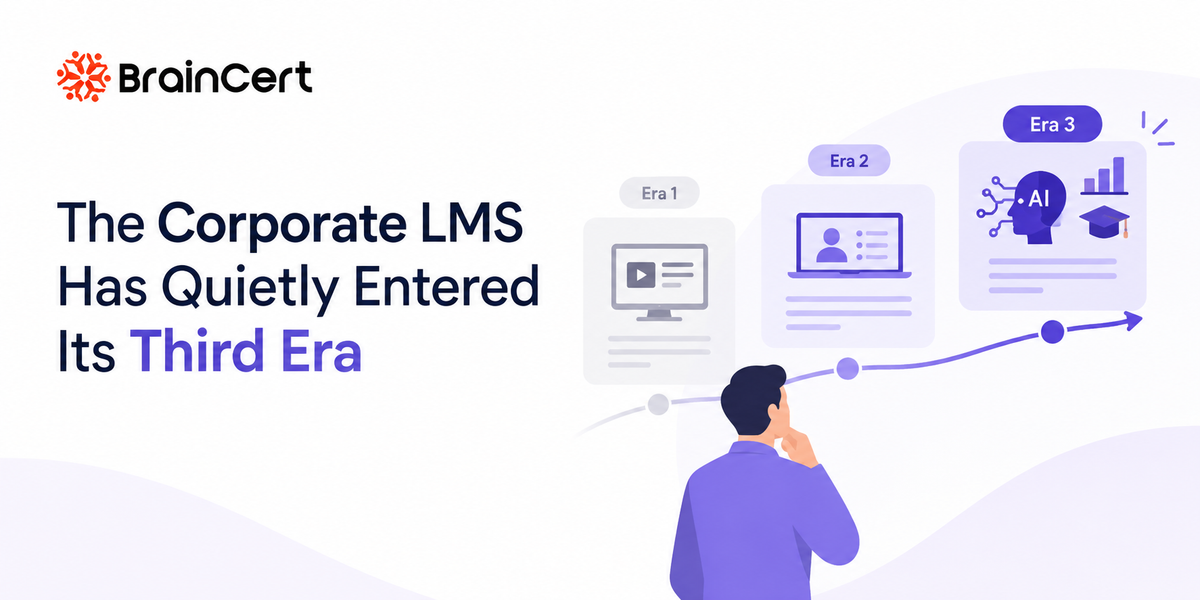
The corporate learning market has gone through three distinct phases in the last decade. First came the LMS-as-repository era, where platforms were glorified file cabinets for slide decks. Then came the video-first wave, when everything pivoted to recorded lectures and watch-time metrics. In 2026, we're firmly in the third phase, and it's the one that actually matters: learning systems that think, automate, and adapt.
If you're an L&D leader, training manager, or HR director evaluating platforms this year, the shelf of "best corporate learning platforms" lists has grown noisier, not clearer. Vendors slap "AI-powered" on every landing page. Every platform claims to drive engagement. So this guide cuts through the noise. We'll look at the capabilities that genuinely separate top-tier corporate LMS platforms from the rest, the questions worth asking during demos, and where BrainCert fits in the broader landscape.
What "Best" Actually Means in 2026
Five years ago, "best" meant the platform with the cleanest UI or the lowest per-user price. Today, that definition has shifted. A great corporate learning platform in 2026 should:
- Run compliance and skill-building side by side, not as two separate tools.
- Use AI where it actually saves time drafting content, generating quizzes, summarizing feedback, not where it just adds a chatbot widget.
- Automate the boring parts: enrollment, reminders, certification renewal, HRIS syncing.
- Show learning impact through real analytics, not just completion percentages.
- Integrate with the tools your team already uses: Slack, Teams, HRIS, payroll.
If a vendor can't speak clearly to these five areas in the first 30 minutes of a demo, they're not a 2026-grade platform. Keep that filter on throughout the rest of your evaluation.
The 7 Capabilities That Define a Top Corporate LMS in 2026
Here's where to look closer.
1. Structured Learning Paths That Mirror Real Roles
A library of 400 courses means nothing if learners don't know which ones apply to their job. Modern platforms lean hard on learning paths, sequenced, role-based tracks that guide an employee from "new hire" to "certified" without guesswork.
Done well, learning paths reduce time-to-competency, give managers a clear onboarding playbook, and make audit trails painless. Done poorly, they become another static PDF checklist. Look for platforms where paths can be assigned by role, cohort, or tag, can include external resources, and can be updated without rebuilding from scratch.
2. Drip Content That Matches Real Workflows
Should learners get all modules on day one, or should content unlock over time? The answer depends on your training goal, and your platform should support both.
For compliance training, drip content is often the better choice; it forces spaced repetition and prevents the "binge-and-forget" trap. For self-serve skill libraries, open access usually wins because learners need to find answers in the moment. The best corporate LMS platforms let you set this per course, not as a global setting. Teams that understand the difference between a learning path and a learning journey tend to make better decisions here, because each model serves a different purpose.
3. AI-Assisted Course Creation, Not AI-Theater
There is a real difference between AI being useful and AI being decorative. A platform that genuinely helps course creation in 2026 will:
- Turn a rough idea or outline into a structured curriculum draft, chapters, lectures, and all
- Generate quiz questions from existing lesson content
- Suggest microlearning summaries from longer videos
- Support localized content for global teams
A platform that's just bolting on a generic chatbot and calling it "AI tutoring" is selling you 2022 software with a 2026 sticker. Push demos past the marketing layer and ask for live walkthroughs on your own content, and ask specifically which of these the AI actually does today versus what's on a roadmap slide.
4. Smart Assessments, Including Pre/Post Comparisons
Quizzes are table stakes. What separates top-tier platforms is assessment analytics that tell you whether learning actually happened.
Look for built-in support for Likert surveys and pre/post comparison reports. These let you measure shifts in awareness, confidence, or behavior across a cohort, far more useful than a single completion percentage. For leadership development, sales enablement, and DEI training especially, this kind of instrument matters. If your platform only tells you "87% completed the course," you're flying blind.
5. Forms, Surveys, and Inline Engagement Tools
Engagement isn't a course property; it's a system property. The best corporate LMS platforms let you embed forms and surveys directly inside the curriculum, not as afterthoughts on a separate tool.
Forms should be able to capture feedback, collect assignments, run onboarding surveys, register event attendees, and trigger follow-up actions like emails, tagging, or internal notifications. When forms live inside your LMS and connect to your automation engine, you stop losing data in spreadsheets and start closing the loop with learners in real time.
6. Compliance Training That People Actually Finish
Most compliance training programs fail not because the content is wrong, but because the delivery is boring and the accountability is fuzzy. The platforms that handle compliance well in 2026 offer:
- Pre-built course templates for common frameworks (GDPR, HIPAA, anti-harassment, anti-money-laundering)
- Automatic renewal reminders
- Audit-ready reporting with timestamped completion records
- Mobile-friendly delivery, since most compliance learning happens off-desk
If a vendor treats compliance as a "starter" feature with no depth, that's a red flag. Compliance is often where the LMS earns or loses its keep inside an organization.
7. Webhooks, Automations, and Real Integrations
This is where the modern LMS quietly outperforms the legacy ones. In 2026, learning platforms aren't isolated portals; they're nodes in your HR and operations stack.
Look for native webhook support, Zapier-style automations, and clean APIs. The use cases are practical: when a course is completed, automatically notify a manager, sync attendance back to your HRIS, or post a celebratory message in Slack. Pair webhooks with API-level actions, and you can run it in reverse too, revoking LMS access the moment your HRIS marks someone as terminated. When a compliance deadline is approaching, trigger an email and a manager notification.
These automations sound small individually, but together they save L&D teams dozens of hours per quarter and make training feel like part of the company rather than an interruption of it.
How to Choose: A 5-Step Evaluation Framework
Once you have your shortlist, run each vendor through the same five-step filter.
Step 1 — Define your must-haves. Write down the three capabilities you cannot compromise on. For most corporate teams, this is a mix of compliance reporting, role-based learning paths, and HRIS integration.
Step 2 — Run a paid pilot. Skip the free trial. Free trials get abandoned; paid pilots get attention. Aim for 30 to 60 days with a real cohort and a real use case.
Step 3 — Test the automation layer. Don't just click through the course player. Build an actual webhook. Run an actual enrollment rule. Connect to a real Slack channel. This is where vendors either shine or stall.
Step 4 — Audit the analytics dashboard. Ask the vendor to walk you through how a manager would answer three specific business questions: Who completed Q3 compliance training? What's the average time-to-competency for new sales reps? Where are learners dropping off in our leadership path? If they need a custom report for any of these, the analytics are underbuilt.
Step 5 — Calculate total cost honestly. Per-user pricing looks simple until you add SSO, premium support, custom branding, and API access. Ask for an itemized quote for year one and year two.

See how BrainCert brings
ompliance, AI course creation, and automation into one platform
Start 14 days free trialWhere BrainCert Fits
BrainCert is built for teams that need the full corporate learning stack without stitching together five different tools. It combines course delivery, assessments (including Likert-style surveys and pre/post reporting), forms with automation hooks, role- and cohort-based learning paths, drip content, and native webhooks under one roof.
For compliance-heavy organizations, the value is concrete: structured learning paths, audit-ready reports, automated renewal reminders, and pre-built templates for frameworks like GDPR, HIPAA, anti-harassment, and anti-money-laundering. For skill-building programs, the AI Course Wizard turns a rough idea into a draft title, description, and full chapter-by-chapter curriculum, and flexible content release models- drip versus open access- let L&D teams move faster without sacrificing structure.
It's not the right fit for every team; no platform is, but if your 2026 evaluation criteria include unified compliance, smart assessments, and real automation, BrainCert belongs on your shortlist.
The Bottom Line
The best corporate learning platform in 2026 isn't the one with the longest feature list. It's the one that removes friction from every step of your training workflow, from authoring to delivery to reporting, and gives your L&D team time back to focus on people instead of process.
Start with the seven capabilities above. Run every vendor through the same evaluation framework. And remember: a great LMS should make learning easier to start, easier to finish, and easier to prove.