
Every great course starts long before the first video is recorded or the first slide is designed. It starts with a plan, a document that maps out exactly what students will learn, in what order, and how you'll know they've learned it. That document is your course outline.
If you've ever stared at a blank screen wondering how to turn your expertise into a structured learning experience, you're not alone. It's one of the most common sticking points for new instructors, corporate trainers, and academic departments alike. This guide breaks down what a course outline actually is, why it matters, the components every strong outline includes, and real examples you can model to help you build your own.
What Is a Course Outline?
A course outline is a structured document that organizes a course's content into a logical sequence of modules and lessons, showing the path a learner takes from where they start to the outcome they're working toward. Think of it as the blueprint for your course: before you build a single lesson, the outline tells you what needs to be taught, in what order, and how success will be measured.
A well-written course outline typically answers four questions:
Plan Your Course with Confidence
Before creating content, answer these four essential questions to build a focused, engaging, and measurable learning experience.
Know Your Audience
Who is this course for, and what prior knowledge or experience do learners already have?
Define Outcomes
What should learners know or be able to do by the end of the course?
Organize Learning
How will your content be structured, delivered, and paced throughout the course?
Measure Success
How will learners demonstrate their understanding through quizzes, assessments, or practical activities?
Course outlines are used everywhere learning happens, in higher education, corporate training and onboarding, professional certification programs, and self-paced online courses. Whether you're an instructor designing a semester-long class or a coach building your first cohort-based program, the outline is the single most important planning document you'll create.
Course Outline vs. Syllabus vs. Curriculum
These three terms get used interchangeably, but they're not the same thing, and understanding the difference will make your planning much clearer.
A curriculum is the broadest term; it's the entire body of courses, standards, and learning goals for a program, subject area, or degree.
A course outline sits one level down: it's the structural plan for a single course, laying out modules, lessons, objectives, and assessments.
A syllabus is typically the student-facing document derived from the outline; it includes the outline's structure plus logistical details like grading policies, attendance rules, contact information, and required materials.
In short: curriculum is the big picture, the course outline is the architecture of one course within it, and the syllabus is what you hand to students on day one.
Why a Course Outline Matters
It's tempting to skip straight to content creation, especially when you're excited about a topic. But building a course without an outline is like constructing a house without a blueprint; you might get something standing, but it probably won't hold together well.
Why a Course Outline Matters
A well-structured course outline does more than organize your ideas. It creates a better learning experience, simplifies course development, and makes future updates much easier.
Keeps Your Content Focused
A course outline prevents scope creep by helping you prioritize topics that directly support your learning objectives. Instead of continuously adding new content, you stay focused on what learners truly need.
Improves the Learner Experience
Learners can clearly see their learning journey from start to finish. This builds confidence, sets expectations, and reduces uncertainty about what's coming next.
Saves Time During Course Creation
Once the outline is finalized, creating videos, writing lessons, and building assessments becomes a straightforward production process instead of continuous planning.
Makes Updates Simple
Organizing content into logical modules and lessons makes it easy to refresh, expand, or rearrange your course without rebuilding everything from scratch.
Supports Compliance and Quality Reviews
In academic and corporate environments, a documented course outline helps meet accreditation, compliance, and instructional design requirements while demonstrating a clear learning strategy.
Key Components of an Effective Course Outline
While formats vary by industry and course type, most effective course outlines include the following seven elements.
Course overview
A summary covering the course's purpose, the target audience, and any prerequisites or prior knowledge learners should have before starting.
Learning objectives
Clear, measurable statements describing what learners will be able to do by the end of the course. Strong objectives use specific action verbs, "apply," "analyze," "build," "evaluate", rather than vague ones like "understand" or "learn about."
Course structure
The breakdown of content into modules and lessons, arranged in a logical sequence so each new concept builds on the last. Most effective courses use 4–8 modules, each containing 3–5 lessons that build toward a specific milestone.
Learning methods and activities
The mix of formats used to teach each concept videos, readings, case studies, discussions, hands-on projects, live sessions, chosen to match how the content is best learned, not just to add variety for its own sake.
Assessments and certification
How you'll measure whether learning objectives were met: quizzes, assignments, projects, exams, or practical demonstrations, along with any certificate or credential learners earn on completion.
Tools and resources
The materials, software, templates, or readings learners will need, clearly marked as required or optional.
Schedule and pacing
A timeline showing when modules are released or when live sessions occur, and how long the course is expected to take, whether it's self-paced, cohort-based, or a hybrid of both.
How to Create a Course Outline: Step-by-Step
Step 1: Define the transformation. Before mapping any content, get specific about what your learner will be capable of after finishing the course that they couldn't do before. Every module and lesson should trace back to this outcome.
Step 2: Know your audience. Build a clear picture of who's taking this course, their current skill level, their goals, and the specific problems they need solved. The more precisely you understand your learner, the more relevant your content will be.
Step 3: Map your milestones. Break the transformation into 4–8 major milestones. Each milestone becomes a module. Ask yourself: "What does the learner need to be able to do before moving to the next stage?"
Step 4: Break milestones into lessons. Within each module, identify 3–5 lessons that build toward that milestone, keeping individual lessons short and focused, ideally 5 to 15 minutes of content each, so learners can make progress without becoming overwhelmed.
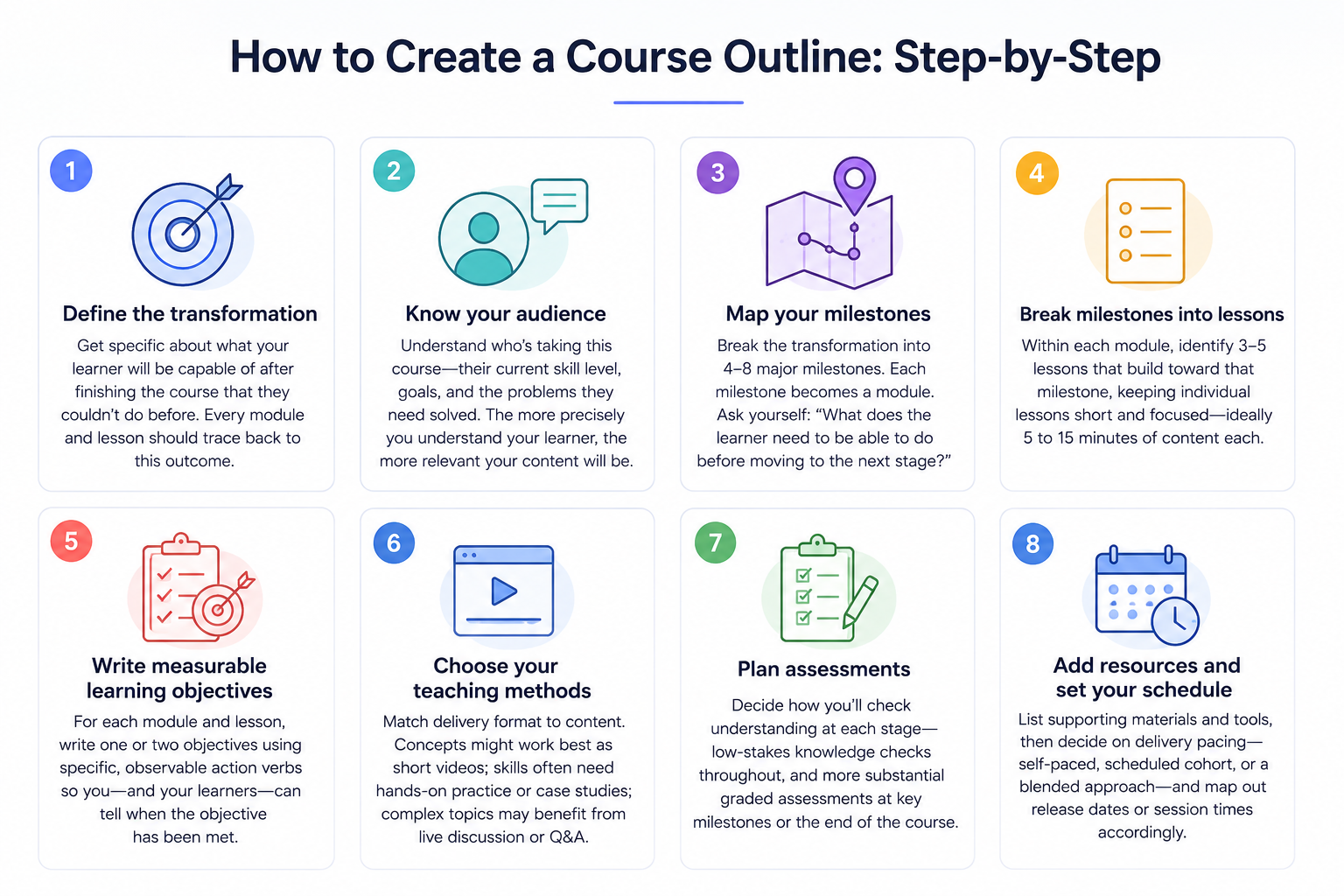
Step 5: Write measurable learning objectives. For each module and lesson, write one or two objectives using specific, observable action verbs so you and your learners, can tell when the objective has been met.
Step 6: Choose your teaching methods. Match delivery format to content. Concepts might work best as short videos; skills often need hands-on practice or case studies; complex topics may benefit from live discussion or Q&A.
Step 7: Plan assessments. Decide how you'll check understanding at each stage: low-stakes knowledge checks throughout, and more substantial graded assessments at key milestones or the end of the course.
Step 8: Add resources and set your schedule. List supporting materials and tools, then decide on delivery pacing- self-paced, scheduled cohort, or a blended approach- and map out release dates or session times accordingly.
Treat the finished outline as a living document rather than a fixed contract. Many instructors refine the outline as they build lessons or gather learner feedback, and that's normal; the goal is a plan that keeps development on track, not one that's set in stone before you've taught a single class.
Course Outline Examples
Seeing a course outline in context makes the structure much easier to apply. Here are three examples across different course types.
Example 1: Self-Paced Online Course (Digital Marketing Fundamentals)
- Module 1: Foundations — Lesson 1: What Is Digital Marketing? Lesson 2: Overview of Marketing Channels. Lesson 3: Setting Campaign Goals.
- Module 2: Social Media Advertising — Lesson 1: Platform Selection. Lesson 2: Building Your First Ad Campaign (required: Facebook Ads guide). Lesson 3: Reading Campaign Analytics (optional case study).
- Module 3: Measuring Success — Lesson 1: Key Metrics and KPIs. Lesson 2: Reporting to Stakeholders.
- Assessment: Final project — build and present a sample campaign plan.
- Schedule: Self-paced, suggested pace of 1–2 modules per week.
Example 2: Corporate Onboarding Course (New Hire Training)
- Module 1: Welcome and Company Overview — Mission, values, org structure.
- Module 2: Tools and Systems — Required software walkthroughs, IT setup, security training.
- Module 3: Role-Specific Training — Department processes, key contacts, first 30-day goals.
- Assessment: Short knowledge checks after each module; manager sign-off at 30 days.
- Schedule: Delivered over the employee's first two weeks, self-paced with two live orientation sessions.
Example 3: Cohort-Based Academic Course (Introduction to Data Analysis)
- Module 1: Data Fundamentals — Data types, collection methods, basic statistics.
- Module 2: Tools of the Trade — Spreadsheets, SQL basics, introduction to visualization tools.
- Module 3: Applied Analysis — Working with a real dataset, concluding, presenting findings.
- Module 4: Capstone Project — Independent analysis project with peer review.
- Assessment: Weekly quizzes, a midterm exercise, and a graded capstone project.
- Schedule: Eight-week cohort, one module released every two weeks with a live weekly Q&A session.

Best Practices and Common Mistakes to Avoid
Creating an effective course outline is about more than organizing topics. Follow these best practices and avoid common pitfalls to build engaging, learner-focused courses.
Start with Learning Objectives
Define what learners should be able to accomplish before planning your content. Build every lesson around those desired outcomes.
Keep Each Module Focused
Every module should cover one clear milestone. If you're teaching multiple unrelated skills, split them into separate modules.
Build in Interactivity
Combine videos with quizzes, discussions, live sessions, and hands-on activities to improve learner engagement and completion rates.
Don't Overload Lessons
Avoid packing too much information into a single lesson. Short, focused lessons are easier to complete and retain.
Don't Skip Assessments
An outline without assessments is simply a content list. Plan quizzes, assignments, or practical activities from the beginning.
Don't Treat the Outline as Final
Refine your outline as you create content and gather learner feedback. The best course outlines continue to evolve over time.
Turn Your Outline Into a Finished Course
A strong course outline is the foundation, but bringing it to life is where the real impact happens. Whether you're building a self-paced online course, running live cohort-based training, or rolling out corporate onboarding at scale, BrainCert's all-in-one LMS gives you the tools to turn your outline into a fully built course, course authoring, live virtual classrooms, assessments, and certification, in one platform.