The learning platform game has changed. Training orgs, certification bodies, associations, and enterprise L&D teams don't want a generic third-party tool anymore. They want their learning environment to feel like their product. That's the whole point of a white label LMS: a fully branded experience running on someone else's infrastructure.
But here's the thing: "white label" is a slippery term. Some vendors just let you swap a logo. Others hand over the entire platform: your own domain, custom workflows, even the ability to run multiple sub-brands under one account. Know that spectrum before you start shopping.
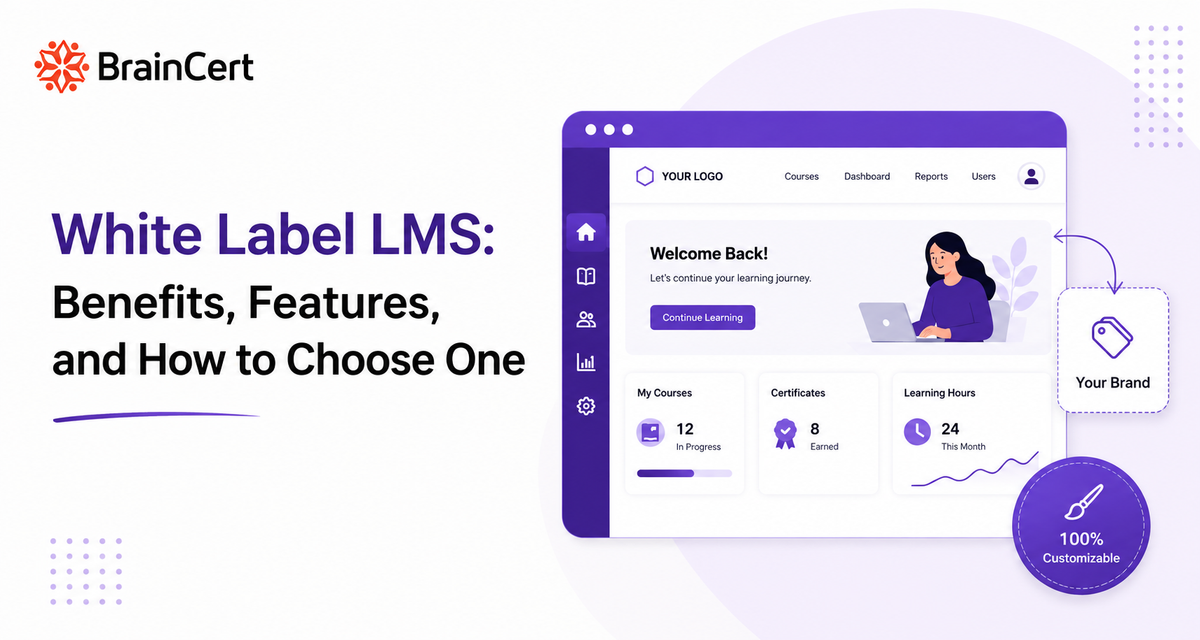
A white label learning management system is a platform you rebrand and operate as your own. Learners never see the vendor's name. The domain, logo, colors, fonts, email templates, certificates, even the mobile app icon- it's all yours.
Architectural Patterns
Two architectural patterns dominate:
- Reseller or single-tenant white labeling — one customer, one branded instance. Fine for a single org that just wants its training portal off the shelf.
- Multi-tenant white labeling — you run the platform as a service, spinning up separate branded portals for clients or business units. This is the model training companies, franchises, and association consortia actually need.
If you serve more than one external audience, or want to monetize training as a product, multi-tenancy isn't optional. Platforms like BrainCert are built around this model, letting operators launch fully branded portals for each client from a single admin console.
The Business Benefits That Actually Matter
Brand trust and learner engagement: Learners stick around when the portal feels like part of their world, not some random SaaS tool. Killing the vendor logo and putting yours up isn't cosmetic; it moves the needle on completion rates, NPS, and renewals. Especially in B2B and regulated sectors.
Speed to market: Building an LMS from scratch can easily run 12–24 months and a seven-figure budget. A white label solution gets you live in weeks. Content delivery, video transcoding, assessments, payment processing- it's all baked in. For training businesses racing against contract cycles, that compression is often the dealbreaker.
Cost predictability: Instead of maintaining a permanent engineering team for learning infrastructure, you license a platform and redirect resources toward content, customer success, and curriculum design. Most vendors price by active learners, active clients, or a flat fee, way easier to model than custom dev.
Scalability without re-platforming: A multi-tenant LMS is built to onboard new clients, courses, and user populations without architectural overhauls. Each tenant gets isolated data, its own URL, its own config, while you run one backend. Launching in a new region or adding a client vertical becomes a configuration task, not a development project.
Revenue optionality: When your LMS supports e-commerce, subscriptions, and tiered pricing, it stops being just a delivery tool and becomes a revenue engine. White label platforms with built-in commerce let you package and price learning products like any other SaaS offering.
Features That Separate a Real White Label LMS From a Skinned One
These capabilities are table stakes for serious operators. If a vendor can't deliver each one, walk away.
Deep customization across the user experience. Look for control over:
- Custom domain mapping (learn.yourbrand.com, not a vendor URL)
- Logo, favicon, and color tokens applied globally
- Branded email templates and transactional notifications
- Custom certificates with your seals, signatures, and verification URLs
- A mobile app published under your developer account, not the vendor's
Multi-tenant LMS architecture. Each client should live in a fully isolated environment—its own users, courses, reports, branding, access policies. Tenant admins manage their own learners without seeing or risking leakage into sibling tenants.
Authoring and course delivery: Modern learners expect more than PDF uploads. A strong platform supports:
- SCORM and xAPI compliance for legacy content
- Built-in video hosting with adaptive bitrate
- Drag-and-drop course builder
- Live classroom and virtual instructor-led training (VILT)
- Assessments with randomized questions, proctoring, and rubric scoring
Reporting and analytics: Operators need both per-tenant dashboards and a cross-tenant roll-up view. Look for skill-gap analysis, completion tracking, time-to-competency metrics, and the ability to export data to your BI tools via API.
Integrations: Your LMS rarely lives alone. Confirm support for:
- SSO (SAML 2.0, OIDC)
- HRIS sync (Workday, BambooHR, ADP)
- CRM handshakes (Salesforce, HubSpot)
- Payment gateways (Stripe, PayPal, regional providers)
- Webhooks and a documented REST API for custom workflows
AI-powered capabilities. This is where the market's heading fast. Modern platforms increasingly bundle AI for content generation, auto-grading, transcription, translation, skills mapping, and personalized learning paths. BrainCert, for example, leans heavily into AI-assisted course creation and adaptive learning paths—big time-savers for operators managing dozens of tenants.
Security and compliance: Confirm SOC 2 or ISO 27001 attestations, GDPR and CCPA tooling, role-based access control, audit logs, and tenant-level data residency options if you operate across regions.
How to Choose: A Practical Decision Framework
A structured evaluation cuts the risk of buying a platform you'll outgrow in 18 months. Here's the sequence.
Step 1 — Define your operating model: Single org internalizing training? Training company selling courses to corporate clients? Franchise or association serving many semi-independent branches? Each model points to a different set of requirements. Internal deployments can usually get by with single-tenant setups; commercial operators can't.
Step 2 — Quantify customization needs. List every element you need to brand or customize. Score each shortlisted vendor on a 1-to-5 scale for depth of control. Pay attention to whether customization is configuration or code; configuration is faster, cheaper, and more sustainable.
Step 3 — Pressure-test multi-tenancy: Ask for a live demo where the vendor creates two tenants on the spot with different branding, courses, and user pools. Verify data isolation by trying to access tenant A from tenant B's admin login. Vendors who stumble here usually struggle in production.
Step 4 — Map the total cost of ownership. License fees are the smallest line item. Model:
- Per-tenant or per-learner pricing tiers
- Overage charges for video, storage, or bandwidth
- Costs of branded mobile apps, if offered
- Integration and professional services
- Ongoing support tier differences
A platform that looks cheap at 500 learners can become the most expensive option at 50,000.
Step 5 — Evaluate the AI and automation roadmap. Ask what shipped in the last six months, not what's on a roadmap slide. AI features that matter for operators include content drafting, auto-tagging, transcription, translation, and adaptive recommendations. A vendor without a credible AI story is falling behind.
Step 6 — Inspect the support and success model. When something breaks at 2 a.m. with 10,000 learners mid-exam, you need to know exactly who picks up the phone. Look for named technical account managers, documented SLAs, and a public status page. Reference customers in your industry are even better.
Step 7 — Plan the exit before you sign. Confirm that your data is portable, that you can export courses, learner records, and analytics in open formats. Avoid vendors who lock content into proprietary formats or charge for export.

Ready to launch your own branded LMS? .
Get Started for FreeCommon Pitfalls to Avoid
Choosing on price alone
A cheap platform with limited multi-tenancy can force a costly migration within two years.
Underestimating integration work
SSO, payment, and HRIS connections can take longer than the sales cycle suggests.
Ignoring mobile
A responsive web portal isn't the same as a native, white-labeled app published in your name.
Treating AI as a checkbox
Ask for measurable outcomes such as hours saved, completion lift, and content production throughput, rather than generic AI feature lists.
Skipping security review
Review tenant isolation, encryption, and access control with your security team before signing the contract.
Final Thoughts
A white label LMS is more than a branding exercise. Done right, it becomes the operating system for a learning business, your brand on the front, scalable infrastructure on the back, enough flexibility to serve multiple audiences without rebuilding for each one.
If you're evaluating options, shortlist platforms that demonstrably support multi-tenant white labeling, AI-assisted authoring, and enterprise-grade integrations. Then run the demo sequence outlined above. The vendor that handles it confidently is usually the one that'll handle your growth.