You're evaluating learning management systems, and you've hit a fork in the road: a traditional LMS with its own branding baked in, or a white-label LMS you can wrap entirely in your own colors, domain, and identity.
It sounds like a surface-level question, a checkbox on a vendor comparison sheet. It isn't. This choice affects how learners perceive your organization, how easily you can scale or resell your training, and whether your LMS ends up feeling like part of your business or a tool bolted onto the side of it.
Let's break it down clearly, no vendor spin, so you can make a decision grounded in what actually matters for your situation.
What Is a Traditional LMS?
A traditional LMS is a learning platform built and owned by a software company. You create an account, log into their interface, and deliver training within their ecosystem. Think of it like renting a furnished apartment: everything's already set up, the furniture's in place, and the landlord's name is still on the lease.
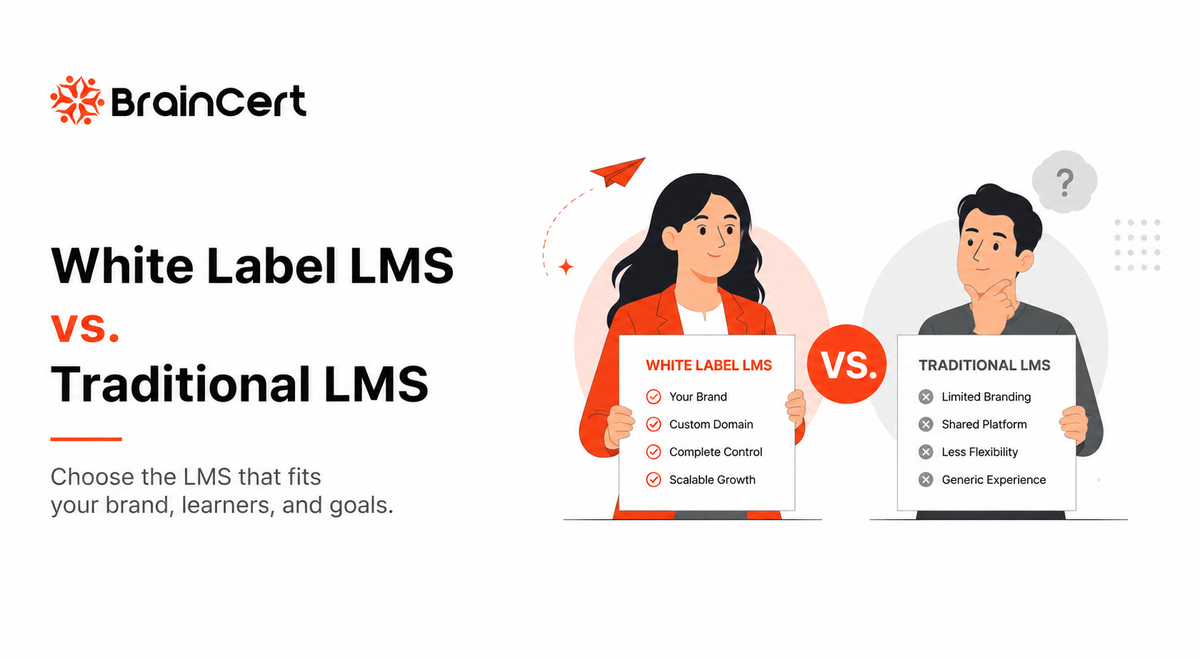
You're typically working inside a shared environment. Learners log into a portal that carries the vendor's branding. Customization is usually limited to a logo upload or a color tweak; the core interface, email templates, and reporting dashboards stay the vendor's design.
That's genuinely fine for a lot of organizations. If your priority is internal compliance training or onboarding, and brand presentation isn't the point, a traditional LMS gets the job done without much overhead.
What Is a White Label LMS?
A white label LMS runs on the same underlying platform, course delivery, assessments, and learner tracking, but you're allowed to rebrand it top to bottom. Your logo, colors, and visual identity carry through every touchpoint: the learner portal, confirmation emails, completion certificates, even the URL learners see in their browser bar.
Back to the real estate analogy: a white-label LMS is like buying a condo. The building has a structure someone else engineered, but the interior is yours to design, and the address is yours to keep.
BrainCert is a good example of how far this goes in practice. Its white-labeled domain support starts at the Bronze plan and scales up through Silver and Gold, which add branch SSL domains for running separate branded environments under one parent account, plus a grey-label learner mobile app, so your academy shows up as yours in the app store too, not as "BrainCert."
The Key Differences That Actually Matter
Branding and Learner Trust
When a learner finishes a course on a white-label platform, they never see another company's name in the corner of the screen. That sounds like a small thing. It isn't; it has real, measurable implications for how learners perceive who's actually behind the training.
If you're a training company selling professional development courses, you want the entire experience, signup to certificate, to read as yours. A white label LMS makes that seamless. With a traditional LMS, learners are quietly reminded, screen after screen, that they're inside somebody else's tool. For internal training, that's a non-issue. For anything client-facing or revenue-generating, it changes how the training is perceived.
Customization Scope
Traditional LMS platforms offer customization within fixed boundaries; you can usually brand the surface, but you're working inside the vendor's design framework.
White label platforms tend to go deeper: custom login pages, personalized learning paths, branded certificates, tailored reporting. On BrainCert specifically, that includes drip-fed course content (releasing lessons on a schedule rather than all at once), and forms built directly into the course curriculum, including Likert-style survey questions for structured feedback and assessment, not just multiple-choice.
If your program has specific learner-journey requirements, a staged path through content, survey-based assessments, or enrollment workflows tied to how your business actually operates, a white-label platform generally gives you more room to configure it that way.
Scalability and Reselling
This is where the difference stops being cosmetic and becomes strategic. If you're a training company or consultancy planning to resell courses under your own brand, a white-label LMS isn't a nice-to-have; it's close to mandatory. You can't build a training brand on top of someone else's name in the URL bar.
A traditional LMS suits organizations running training as an internal function, HR teams, internal L&D, and compliance-focused groups that don't need, or want, the overhead of full rebranding.
White-label platforms also tend to support multi-tenant setups more naturally. BrainCert's reseller program, for instance, is built around exactly this: creating and selling multiple branded training platforms, all managed from a single dashboard, which is the practical difference between "using an LMS" and "running a training business on top of one."
Cost Structure
Traditional LMS platforms often have the edge here, at least at first. Pricing tends to be straightforward per-user or subscription-based, and setup is usually faster since you're adopting a ready-made interface.
White-label platforms can involve more upfront configuration, domain setup, custom branding, and integrations with your existing tools. That said, hosted white-label options reduce a lot of that lift; BrainCert's Enterprise tier, for example, includes white-glove onboarding specifically to handle that heavy lifting for you.
The real cost question isn't just the subscription line. It's long-term value. If rebranding helps you close more training contracts, build a recognizable course brand, or charge premium prices, the white label investment tends to pay for itself well before year two.
Integration and API Access
Both LMS types can offer integrations, but white label platforms are typically built with more developer-friendly architecture, since they're often serving organizations with specific technical requirements from day one.
Modern white label platforms connect to CRMs, HRIS systems, webinar tools, and communication platforms through webhooks and APIs. BrainCert supports automations that fire on real LMS events, enrollments, course completions, assessment results, form submissions, certificate issuance, and trigger actions like CRM updates, auto-enrollment into a next course, or role-based training assignments, on top of native APIs, webhooks, and Zapier integrations.
These integrations matter more as your program grows. At a certain size, you need the LMS to fit into a broader operational stack rather than sit off to the side as its own island.
A Real-World Comparison
Two organizations, two very different answers to the same question:
Organization A is a mid-sized healthcare company delivering mandatory compliance training to 500 employees twice a year. Small budget, minimal IT support. They need something that works out of the box, tracks completions, and sends reminders. A traditional LMS fits this well; the vendor's branding is irrelevant to their learners, who just need to finish the course and get a record of it.
Organization B is a digital marketing agency selling a certification program to freelancers and in-house marketing teams. They want a branded portal, learning paths that walk people from beginner to advanced, and certificates that carry the agency's name — plus the option to eventually offer white-labeled versions to partner agencies. For them, a white-label LMS isn't optional. It's the foundation the business model sits on.
Both choices are correct for the organization making them. The point is matching the platform to the actual business goal, not picking whichever one has the longer feature list.
When to Choose Each
Go with a traditional LMS if:
- Your training is primarily internal and employee-facing
- Budget and speed of deployment matter more than brand control
- Branding consistency across the learner experience isn't a business requirement
- Your needs are straightforward: course delivery, basic tracking, simple assessments
- You have no plans to resell or white label your training
Go with a white label LMS if:
- You deliver training to external clients or customers
- Building a recognized training brand is part of your growth strategy
- You need deeper customization of the learner experience, certificates, or reporting
- You plan to resell or white label courses to other organizations
- Your workflow requires custom integrations with tools you already run on
- You want full control over the learner-facing domain and visual identity

The Middle Ground Worth Considering
The line between traditional and white label has blurred. Plenty of modern platforms, BrainCert included, offer white labeling as a standard feature rather than a costly add-on, which means you don't have to choose between ease of use and brand control.
If you're just starting out and unsure what you'll need in eighteen months, a platform that gives you white-label options without locking you into expensive custom development is the pragmatic call. Start with straightforward course delivery, then build out deeper customization, branded portals, custom learning paths, AI-assisted course creation, advanced assessments, as your program actually grows into needing it.
Making the Decision
The real question isn't "which is better?" It's "which fits how we actually use training in our organization?"
If training is a support function, something your team runs to check a compliance box, a traditional LMS keeps things simple, and that's a perfectly good outcome. If training is a core product, a revenue stream, or a brand-building tool, a white-label platform gives you the control and professionalism the situation actually demands.
Take stock of your real requirements before you evaluate vendors. Build your decision criteria around your learners, your business goals, and where you want to be in two years, not just the feature list in front of you.
The right LMS isn't the most powerful one on paper. It's the one that fits the problem you're actually trying to solve.