

You've designed the course. Uploaded the content. Sent the enrollment links. And for the first week, things look promising, people are logging in, starting modules, clicking through slides.
Then, quietly, they stop.
Research consistently shows that learners forget roughly 70% of new information within a single day when it isn't reinforced. The dropout problem in online learning is real. But it's not unfixable. Understanding why people leave is the first step to keeping them.
The Real Reason People Quit
Most organisations assume dropout is a motivation problem.
The learner wasn't interested enough. The content wasn't engaging enough. The timing was off.
But research tells a different story.
A landmark systematic review of over 110 studies found that learner satisfaction, motivation, and self-management skills, not access to technology, are the leading drivers of dropout in online learning. And a 2025 study found that post-pandemic, the quality of instructional design and perceived relevance of learning content are now more decisive predictors of persistence than anything else.
In other words, people aren't leaving because they don't want to learn. They're leaving because the experience doesn't give them a good enough reason to stay.
There are five psychological mechanisms at work here, and they show up consistently across industries, audiences, and platforms.
What's Actually Happening in the Learner's Mind
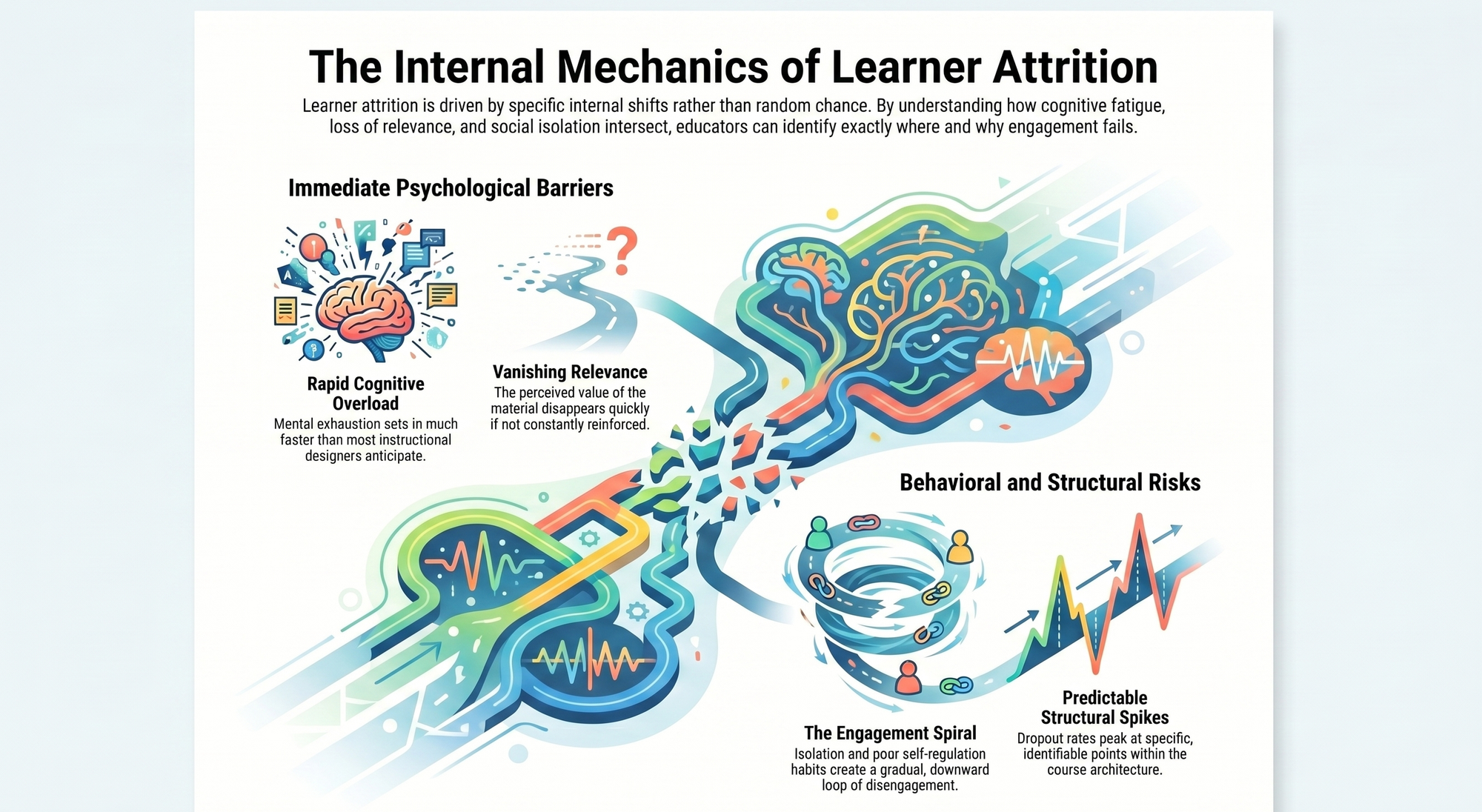
Cognitive overload sets in faster than you think.
When a course throws too much information at a learner too quickly, dense slides, long videos, and back-to-back modules, the brain's working memory hits a ceiling. This is cognitive overload, and it doesn't just slow learning down. It triggers a very human response: avoidance. The learner doesn't consciously decide to quit. They just keep finding reasons to come back to it later. And later never comes.
Poor instructional design is the most common culprit. When content isn't sequenced thoughtfully, or when it doesn't map clearly to what the learner already knows, the extraneous load overwhelms the essential learning.
Relevance disappears quickly.
Adult learners, in particular, need to know why something matters to them, and they need to know it within the first few minutes of a course. When that connection to real work, real outcomes, or real problems isn't established early, motivation evaporates. Research confirms this: the perceived relevance of a learning experience is one of the strongest predictors of whether a learner will see it through.
This is especially acute in corporate training. If an employee can't immediately see how a module applies to their role, it becomes just another task to complete, and tasks with no clear payoff are easy to deprioritise.
Isolation erodes engagement gradually.
Online learning removes the social glue that classroom learning takes for granted. There's no colleague to turn to, no shared struggle, no moment of group laughter when something doesn't make sense. For many learners, this absence of social connection quietly chips away at their sense of belonging in the course, and with it, their motivation to continue.
Research specifically identifies learner isolation as one of the main causes of dropout in e-learning. The feeling of being alone in a digital environment reduces participation, lowers satisfaction, and increases the chance that a learner will simply stop showing up.
Self-regulation gaps create a spiral.
Online courses demand more self-direction from learners than any other learning format. There are no fixed class times, no peers watching, no teacher following up. For learners who already struggle with self-regulation, setting their own deadlines, managing their own progress, and staying accountable without external pressure, this freedom becomes a liability.
When these learners miss a session, unfinished content piles up. That pile creates cognitive and emotional pressure, what researchers call a "pile-up effect", a self-reinforcing spiral where falling behind makes re-engaging feel progressively harder. Studies show that only 36% of learners who drop out for a single week re-engage within two weeks. The longer the gap, the less likely they are to return.
Dropout spikes at predictable points, and they're structural.
Here's something most course creators don't know: dropout isn't random. Research found a consistent "cliff effect" at chapter transitions, points where the course moves from one topic to the next. These transition moments are where disengagement spikes, and the effect becomes more pronounced as the course progresses.
This means the structure of the course itself is a dropout risk factor. Every time a learner reaches the end of a section, there's a moment of decision:
Do I continue, or do I stop here?
Without the right design and the right nudges in place, many choose to stop.
The Warning Signs Most Teams Miss
By the time a learner's completion status turns red in your LMS, they've usually been disengaging for a while. The real early signals are subtler.
Watch for learners who log in but don't interact; they open the course, scroll through a slide or two, and close the tab. Passive attendance is a precursor to dropout, not a sign of engagement. Watch for delayed starts, where learners enroll but don't begin until well past the intended date. And watch for long gaps between sessions, because research shows that each day of absence increases the likelihood of permanent disengagement.
The platforms and tools you use should make these patterns visible before they become a problem. Learning analytics that surface behaviour, not just completion percentages, give L&D teams and course creators the ability to intervene at the right moment, rather than after the fact.
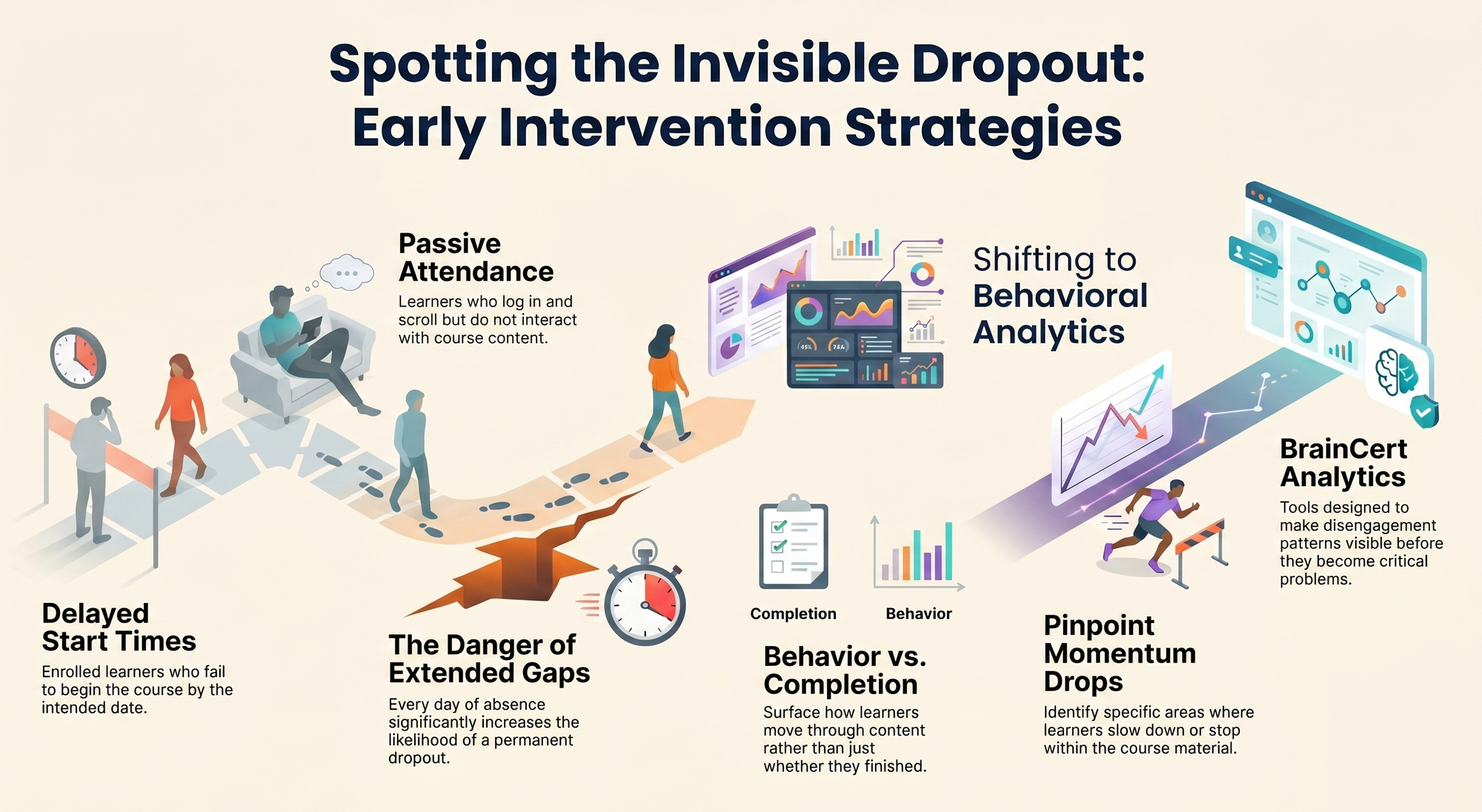
BrainCert's built-in analytics are designed with exactly this in mind. Rather than showing you who's finished, they show you how learners are moving through your content, where they slow down, where they stop, and where momentum drops. That distinction changes what you can do about it.
Six Ways to Actually Reduce Dropout
Understanding the psychology is half the work. The other half is designing against it. These six strategies are grounded in research and practically applicable, whether you're building a 10-module onboarding programme or a 40-hour certification course.
Redesign for the working memory, not the curriculum.
Break content into genuinely short, focused units. Not "short" as in 10-minute videos, short as in one idea, one outcome, one thing the learner can do or know by the end of it. Microlearning reduces cognitive load not by dumbing content down, but by giving the brain space to process before the next concept arrives. Think in terms of what can be learned, applied, and recalled in a single sitting. Then build your course out of those units, not the other way around.
Anchor relevance on day one.
The first module of any course should answer one question before anything else: why does this matter to you, in your job, right now? Not in abstract terms, in specific, concrete terms that connect to the learner's actual work. If you can frame the learning around a problem the learner already has, or an outcome they already want, you've bought yourself attention and motivation before the course has even properly started.
Build social accountability into the design.
Community and peer interaction aren't nice-to-haves; they're dropout prevention tools. Discussion boards, cohort-based schedules, peer review activities, and even simple check-in prompts can substantially reduce the sense of isolation that drives learners away. BrainCert's discussion and live virtual classroom features support exactly this kind of social learning infrastructure. When learners know others are moving through the course alongside them, the motivation to keep up becomes intrinsic rather than imposed.
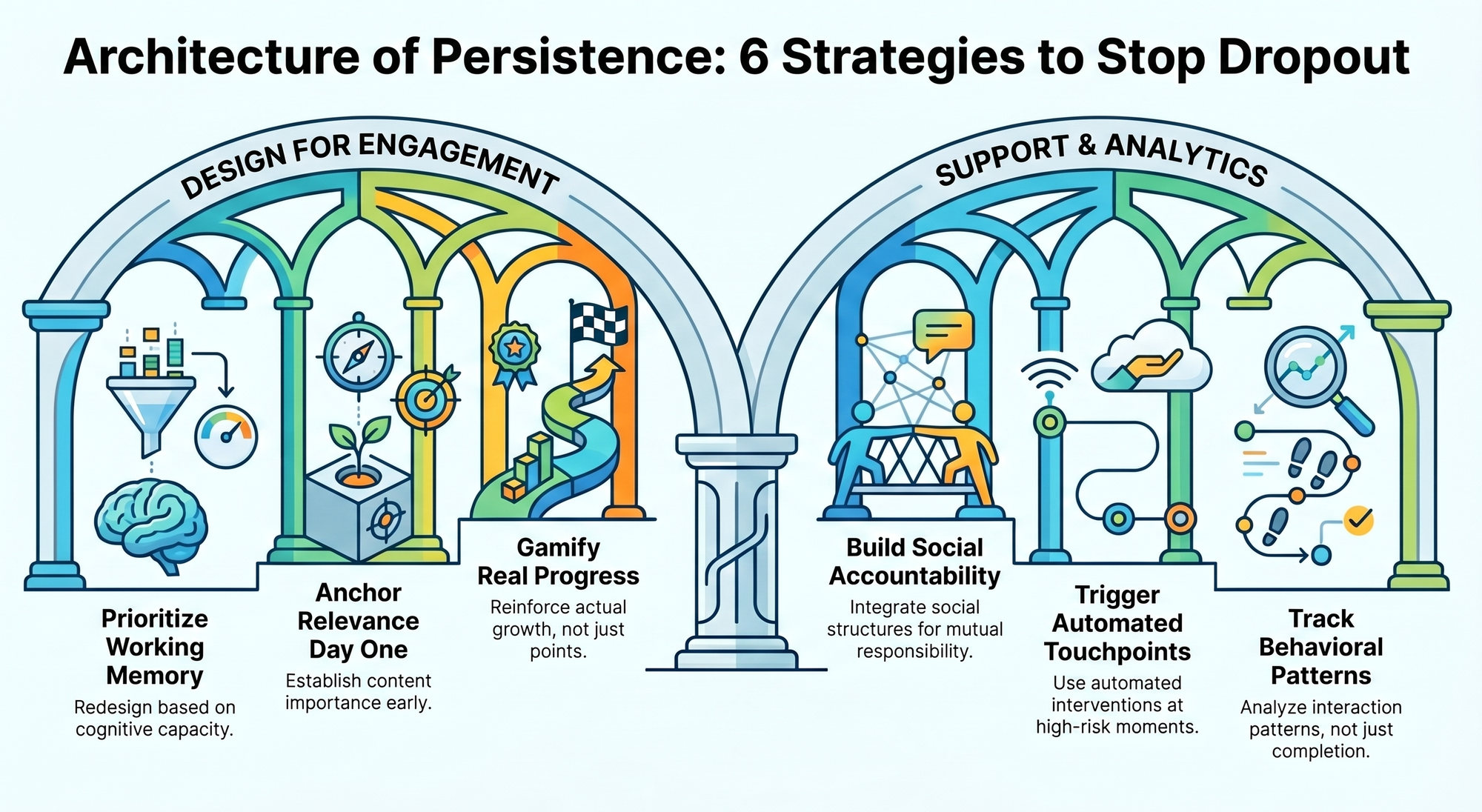
Use automated touchpoints at high-risk moments.
Since dropout spikes at chapter transitions, design your communication around those moments. An automated nudge, a reminder, a contextual message, a "you've reached the halfway point" prompt, at the end of each major section, keeps momentum from stalling. This isn't about nagging. It's about removing the friction of re-entry. A well-timed prompt before a learner has had time to drift lowers the psychological barrier to continuing significantly.
Use gamification that reinforces progress, not just points.
Done well, gamification creates a feedback loop; it tells learners they're making progress, recognises effort, and makes the distance between where they are and where they're going visible. Progress bars, milestone certificates, completion badges, and streak indicators are lightweight ways to sustain motivation between sessions. The key is tying every gamified element to genuine learning progress, not administrative compliance.
Track behaviour, not just completion.
Measuring course completion alone tells you almost nothing useful. It tells you who finished, not why others didn't, where they lost interest, or what you could do differently. A behaviour-first analytics approach tracks time-on-task, interaction rates, session patterns, and re-attempt behaviour. These data points let you identify friction in your course design and fix it before the next cohort arrives. BrainCert's reporting suite makes this level of insight accessible without needing a data team to interpret it.

What Good Platform Design Makes Possible
The strategies above are achievable with the right infrastructure. But trying to implement them on a platform that wasn't designed with learner psychology in mind means building workarounds on top of workarounds.
A well-designed LMS doesn't just deliver content, it anticipates where learners are likely to disengage and gives you the tools to act before they do. That means adaptive learning paths that adjust based on performance, automated reminder workflows tied to learner behaviour, visibility into engagement at the individual level, and social features that make the learning feel like a shared experience rather than a solitary task.
BrainCert brings together virtual classrooms, course authoring, assessments, and analytics in a single environment, so L&D teams and course creators can see the full picture of learner behaviour and respond to it in real time. The goal isn't to push learners toward a completion tick. It's to create learning experiences that learners actually want to finish.
If your current platform only tells you who completed and who didn't, you're already working with incomplete information.
To Conclude
Dropout isn't a learner problem. It's a design problem.
When online learning is structured well, made relevant, supported socially, and tracked behaviourally, completion rates improve, knowledge sticks, and the investment in training pays off. When it isn't, even motivated learners drift away.
If you're ready to find out what that looks like in practice, explore BrainCert, and see how a learner-psychology-aware platform changes what's possible for your training programmes.
Frequently Asked Questions
Everything you need to know about learner engagement and course completion.
What is the average dropout rate for online courses?
Most online courses have completion rates between 5% and 15%. Corporate training often performs slightly better. In many cases, learners drop out because the course experience is not engaging enough, not because they lack motivation.
Why do employees quit online training halfway through?
Learners often stop because the content feels overwhelming, irrelevant, or difficult to keep up with. Missing a session can also make it harder to return later, especially without reminders or support.
What is the “pile-up effect” in e-learning?
The pile-up effect happens when learners fall behind and unfinished lessons start stacking up. As the backlog grows, learners may feel stressed or discouraged, making them less likely to continue the course.
How does instructional design affect course completion?
Good instructional design makes learning easier and more engaging. Courses with clear structure, shorter lessons, and relevant content usually achieve better completion rates and learner retention.
What LMS features help reduce learner dropout?
Features like learner analytics, automated reminders, discussion forums, live sessions, progress tracking, and personalized learning paths can help learners stay engaged and complete their courses.
Can gamification improve course completion?
Yes. Features like badges, progress bars, and streaks can motivate learners to keep going. Gamification works best when it rewards real learning progress instead of just adding points or visuals.
How is BrainCert different from other LMS platforms?
BrainCert combines course creation, virtual classrooms, assessments, discussion tools, and learner analytics in one platform. It helps you understand where learners lose interest so you can improve the learning experience and increase completion rates.