Picking an enterprise LMS isn't a small decision. You're choosing the platform that will onboard new hires, run compliance training, support professional development, and prove its value to leadership.
It also has to work across departments, geographies, and very different types of learners. No pressure, right?
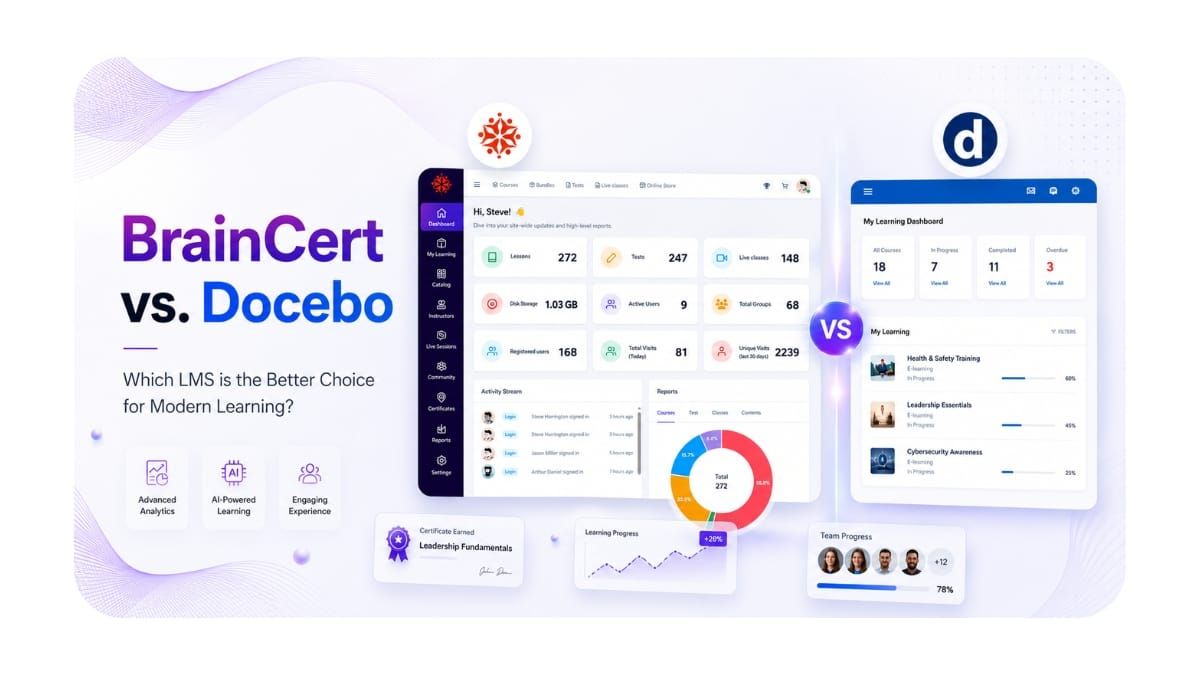
BrainCert and Docebo both come up a lot in these conversations. They're both solid platforms, but they're built on very different philosophies. This guide breaks down the real differences so your L&D or HR team can make a confident call.
What Each Platform Was Actually Built to Do
Docebo was designed for large organizations with a lot of moving parts. Its architecture leans into AI-driven content curation, social learning, and deep integration with enterprise HR systems like Workday, SAP SuccessFactors, and Salesforce. It's built to manage hundreds of thousands of learners at once.
BrainCert takes a different approach. It bundles a full LMS, virtual classroom, assessment engine, course authoring tool, e-commerce, and compliance management into one platform.
Instead of buying and stitching together five separate tools, you get one place to create, deliver, track, and even sell your training.
That difference in philosophy shapes everything else. Docebo assumes you already have (or plan to build) a wider tech stack around it. BrainCert aims to be the stack.
Course Creation and Content Management
Content is the foundation of any learning program. How easily your team can build, organize, and ship that content directly affects your rollout timelines and how engaged your learners actually are.
Docebo
Docebo's biggest strength is its content marketplace. It aggregates third-party libraries like LinkedIn Learning and Skillsoft, then uses AI to recommend relevant courses based on role, behavior, and skill gaps.
For original content, Docebo offers Shape, a native authoring tool that uses AI to turn existing documents into microlearning.
Shape works well for short, bite-sized modules. But for complex course builds, multi-module certifications, or scenario-based training with real assessment logic, many enterprise teams still end up reaching for an external authoring tool.
BrainCert
BrainCert includes a full course builder that supports SCORM, xAPI, video, documents, presentations, live classes, and interactive assessments, all natively. You can build structured learning paths that guide learners through a curated sequence of courses, modules, and assessments.
One feature enterprise teams especially like: drip content scheduling. Instead of dumping an entire course library on a new hire in week one, you release content on a schedule, day by day or week by week.
That pacing matters a lot for onboarding and compliance training, where the order learners see things in actually matters.
BrainCert also builds in AI-assisted content creation, helping L&D teams generate quiz questions, summarize content, and structure modules faster.
Practical takeaway: Docebo's marketplace is great for aggregating third-party content at scale. BrainCert gives you more native control over custom content and how granularly you deliver it.
Assessments and Measurable Learning Outcomes
Enterprise L&D is under constant pressure to prove ROI. Assessments aren't just pass/fail gates anymore. They're how you gather real data on learner progress, knowledge gaps, and program effectiveness.
Docebo
Docebo covers the basics well: quizzes, tests, and simple surveys. For anything more advanced, like psychometric analysis, branching logic, or detailed survey instruments, you'll typically need to bring in a third-party assessment tool. That means more cost and more moving parts.
BrainCert
BrainCert has a built-in, enterprise-grade assessment engine with multiple question types, timed tests, randomized question pools, and Likert-scale surveys.
The Likert survey feature is genuinely useful for measuring training effectiveness. You can run pre- and post-training surveys, automatically match questions across both, and generate comparison reports showing exactly how learner knowledge and perceptions shifted.
That pre/post analysis is exactly what you need when leadership asks, "did this training actually work?"
BrainCert's reporting also includes learner-level views, program summaries, and exportable data, so compliance teams and L&D managers can pull the reports they need for audits or executive reviews without extra tools.
Practical takeaway: BrainCert's native assessment engine is a real advantage for teams that need deep measurement capability without bolting on outside software.
Virtual Classroom and Live Training
Enterprise learning isn't all self-paced. Instructor-led training, live workshops, and hybrid sessions still matter a lot for leadership development, soft skills, and compliance.
Docebo
Docebo integrates with Zoom, Microsoft Teams, and Webex for live sessions. You can schedule and manage instructor-led training through Docebo's ILT module, but the actual session happens in a separate tool.
That works, but it also means managing extra licenses, keeping integrations connected, and dealing with learner data that lives in two places during every session.
BrainCert
BrainCert has a built-in virtual classroom with HD video, screen sharing, a collaborative whiteboard, breakout rooms, session recording, and interactive tools. No third-party integration required.
That matters for enterprises because attendance, participation, and completion data flows straight into the LMS with no sync issues. You're also not paying for a separate Zoom or Teams license on top of your LMS subscription.
And if you're in a regulated industry where you need to prove someone actually attended and participated in a live session, having it all in one platform closes the gaps that usually show up in compliance documentation.
Practical takeaway: If live training is a real part of your learning mix, BrainCert's built-in virtual classroom removes the integration headaches and data fragmentation that come with Docebo's third-party setup.
Learning Paths, Journeys, and Learner Experience
Modern L&D teams think in terms of structured experiences, not just standalone courses. "Learning path" and "learning journey" get used interchangeably, but they're not quite the same thing.
A learning path is a defined sequence of courses and assessments. A learning journey is broader and might include paths, social learning, mentoring, on-the-job activities, and reflection.
Docebo supports both through its Discover, Coach & Share features and its learning path builder. It's a strong fit for organizations that want to blend formal and informal learning with AI-curated recommendations.
BrainCert's learning path builder is more straightforward, but just as capable for structured programs. You can set prerequisites, define completion criteria, mix self-paced courses with live sessions, and layer in assessments and feedback surveys at each stage.
For compliance-heavy environments, where you need a clear, auditable trail of who completed what and when, that structured approach is usually the better fit.
Practical takeaway: Docebo excels at blending structured and social learning. BrainCert excels at structured, auditable programs where compliance and completion tracking come first.

Ready to see BrainCert in action?
Compare it against your current shortlist
Integrations and Extensibility
Enterprise environments are complicated by nature. Your LMS needs to talk to your HRIS, CRM, communication tools, and reporting systems.
Docebo
Docebo has a mature integration ecosystem with pre-built connectors for major enterprise systems. Its API is well-documented, and it supports webhooks and SSO (SAML and OAuth). If your organization is deeply embedded in Salesforce or Workday, Docebo's native connectors are a real advantage.
BrainCert
BrainCert supports webhooks, automations, and modern integration patterns that let enterprise teams connect the LMS to the rest of their tech stack. You can trigger actions in external systems based on learner events, course completions, assessment scores, and form submissions.
For example, when a learner finishes a compliance module, BrainCert can automatically trigger a webhook to update your HRIS, notify their manager, and log the completion in your audit system.
That kind of event-driven automation is exactly what fast-growing enterprise L&D teams need to scale without adding headcount.
Practical takeaway: Docebo has broader pre-built integrations for enterprise HR systems. BrainCert offers flexible webhook and automation capabilities that give technical teams fine-grained control over how learning data moves across the organization.
Pricing and Total Cost of Ownership
This is where the comparison gets real for most enterprise buyers.
Docebo's pricing is quote-based and typically starts in the mid-five-figure range annually for enterprise deployments. Costs scale with learner count, feature tier, and add-on modules. Many organizations discover that features they assumed were core, like advanced reporting, certain integrations, or ILT management, actually require higher-tier plans or paid add-ons.
BrainCert's pricing is generally more transparent and accessible. Plans bundle the core LMS, virtual classroom, assessments, and content authoring into a single subscription, which means fewer surprise costs and a more predictable total cost of ownership.
The hidden costs add up fast with Docebo. You may need to budget separately for:
- A separate virtual classroom tool (Zoom, Teams, etc.)
- External course authoring software for complex builds
- Advanced reporting and analytics add-ons
- Third-party assessment tools for high-stakes testing
- Integration development or consulting
BrainCert's all-in-one package typically cuts down on these variable costs and simplifies your vendor relationships.
Making Your Decision
Both platforms serve enterprise learning well. The right pick really depends on where your organization is starting from.
Choose BrainCert if you want an integrated platform that cuts down on tool sprawl, simplifies compliance tracking, and gives you transparent pricing. If you need native assessment depth, a built-in virtual classroom, granular content scheduling, and structured, auditable learning programs, BrainCert's all-in-one approach delivers more value per dollar.