
Choosing a Learning Management System (LMS) isn’t just about ticking off a list of features. It’s a strategic decision that impacts how your learners engage, how your organization scales, and how easily you can adapt to future training needs.
But with hundreds of vendors and countless overlapping features, the search can get overwhelming fast. That's where an LMS RFP (Request for Proposal) comes to the rescue. A well-structured RFP helps you cut through the noise, focus on what really matters, and compare vendors side-by-side.
This guide walks you through everything you need to know about LMS RFPs, including a free template to get you started.
What Is an LMS RFP?
An LMS RFP is a structured document you send to potential vendors. It outlines your goals, technical requirements, timelines, and budget so vendors can respond with tailored proposals.
It’s your roadmap for finding the best learning platform for your needs.
Why it matters:
- Aligns all stakeholders (HR, IT, L&D, compliance).
- Ensures vendors respond to your needs & not just sell you features.
- Helps you avoid hidden costs & surprises down the road.
- Speeds up the selection process with side-by-side comparisons.
Common Mistakes When Writing LMS RFPs
Before diving into structure, let’s call out a few pitfalls:
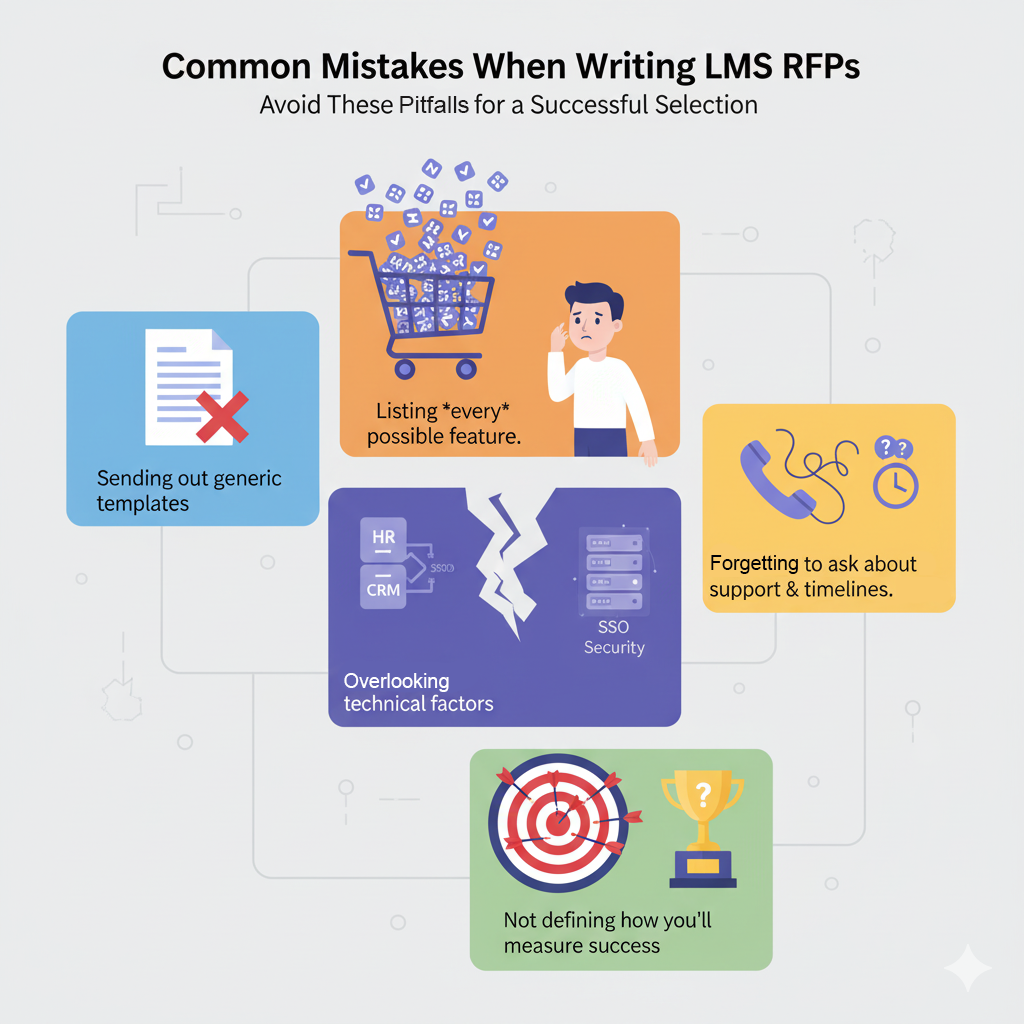
- Sending out generic templates without customizing them to your goals.
- Listing every possible feature instead of clarifying must-haves vs nice-to-haves.
- Overlooking technical factors like integrations, SSO, and data security.
- Forgetting to ask about support, onboarding, and timelines.
- Not defining how you’ll measure success after implementation.
What to Include in a Good LMS RFP
Here’d be a breakdown of the sections & content you should include. Each section would have sample questions or prompts.
| Section | Why It’s Important | Sample Questions / Prompts |
|---|---|---|
| Organization & Project Overview | Gives context to vendors so they can propose relevant solutions. | Who are you (size, industry, mission)? What learners will use this LMS (employee / external / blended)? What is the volume / scale (number of learners, courses, languages, regions)? What’s your current LMS (if any), what works / what doesn’t? |
| Business Goals & Use Cases | Helps align LMS choice with what you want to achieve. | What are your key goals (onboarding, compliance, upskilling, certifications, external training)? Do you have specific use cases (e.g. mobile learners, blended learning, social learning)? Any future plans (expansion, multiple audiences)? |
| Feature & Functional Requirements | Essential to compare vendors on an apples-to-apples basis. | Course management; assessments/quizzes; certifications; mobile access; offline access; social / collaborative tools; authoring tools; LMS UI/UX; reporting & analytics; localization / multilingual; branding / UI customization. |
| Technical & Integration Requirements | Ensures the LMS fits into your tech ecosystem. | API or web-hooks; Single Sign-On (SSO); data import/export; compatibility with existing HR / CRM / content systems; hosting options (cloud vs on-premise); data privacy and security; compliance with relevant laws (e.g. GDPR, ISO, local regulations). |
| Implementation, Support & Training | To make sure vendor can actually deliver. | What is the desired timeline for deployment, migration, pilot/test? What onboarding/training is expected (for admins / instructors / learners)? Support model: SLAs, customer success, technical support, upgrades / updates. |
| Pricing & Licensing | Budget clarity and avoiding surprises. | Pricing model (per user, per active user, per feature, seat-based, tiered); extra costs (customization, integrations, content creation, support); renewal terms; hidden fees (maintenance, uptime, add-ons). |
| Evaluation & Selection Criteria | How you’ll judge the proposals. | Weighted scoring (features vs cost vs timeline etc.); vendor references / case studies; demos or sandbox access; proof of performance; total cost of ownership; flexibility. |

Key Sections to Include in Your LMS RFP
Creating a strong LMS RFP means more than just listing requirements. Each section should clearly communicate your organization’s needs, expectations, and priorities so vendors can respond with relevant proposals.
Here’s a detailed framework to guide you:
1. Organization & Project Overview
Provide context about your organization and the training initiative. This helps vendors tailor their proposals to your environment. Include:
- Organization profile: size, industry, mission, and business objectives.
- Audience: who will use the LMS? Employees, customers, partners, or a combination.
- Current training landscape: existing LMS (if any), current challenges, and pain points.
- Project scope: number of learners, courses, languages, regions, and planned rollout phases.
2. Business Goals & Use Cases
Clearly communicate why you need an LMS and what success looks like. Include:
- Primary goals: onboarding, compliance training, upskilling, certification programs.
- Specific use cases: mobile learning, blended learning, social or collaborative learning, multilingual content.
- Future growth: plans to scale training to new audiences, global expansion, or additional learning programs.
3. Functional Requirements
Specify the capabilities your LMS must have to meet your learning goals. Include:
- Course creation and management tools.
- Assessments, quizzes, and certification tracking.
- Reports & analytics, and dashboards for admins and stakeholders.
- Gamification, social learning, discussion forums, and engagement features.
- Branding, UI customization, and learner personalization options.
4. Technical & Integration Requirements
Ensure the LMS can integrate seamlessly with your existing technology and meet security standards. Include:
- API availability and webhook support.
- Identity management: Single Sign-On (SSO), SAML 2.0, OAuth 2.0, LDAP.
- Integrations with HR systems, CRMs, content platforms, and other business tools.
- Hosting preferences: cloud vs. on-premise, multi-tenant support.
- Data privacy and compliance: GDPR, HIPAA, ISO certifications, or local regulations.
5. Implementation, Support & Training
The rollout and ongoing support can make or break an LMS deployment. Include:
- Estimated implementation timeline and milestones.
- Migration assistance from your current LMS or existing content.
- Training for administrators, instructors, and learners.
- Ongoing vendor support, including SLAs, helpdesk availability, and customer success resources.
6. Pricing & Licensing
Avoid unexpected costs by requesting clear pricing information. Include:
- Pricing model: per user, per active user, flat rate, or tiered.
- Additional fees for customization, integrations, or extra support.
- Renewal terms, licensing limits, and upgrade or expansion costs.
7. Evaluation & Selection Criteria
Explain how you will evaluate proposals to ensure fairness and clarity. Include:
- A scoring matrix that weights features, cost, support, and timeline.
- Vendor references, case studies, or success stories.
- Access to demos or sandbox environments to test the LMS firsthand.
- Proof of performance such as uptime guarantees, security certifications, and real-world results.
Tips for a Successful RFP Process
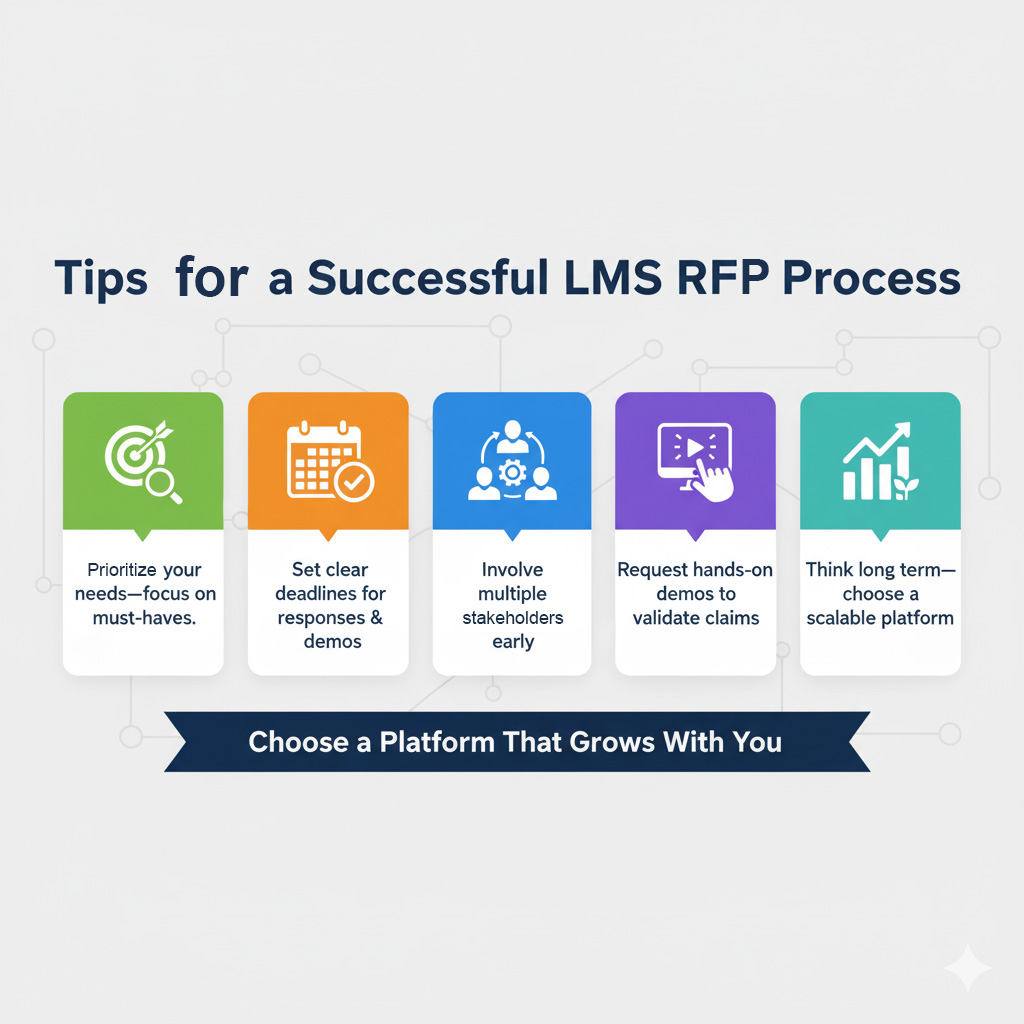
- Prioritize your needs; not every shiny feature matters.
- Set clear deadlines for responses and demos.
- Involve multiple stakeholders early in the process.
- Request hands-on demos to validate claims.
- Think long term, choose a platform that grows with you.
Free LMS RFP Template
We’ve created a ready-to-use LMS RFP template you can download and customize. It includes all the sections above, with sample questions you can tweak for your organization.
Next Step: Share this RFP template with potential vendors, set deadlines for responses, and use a scoring matrix to compare proposals objectively.
Final Thoughts
Choosing the right LMS doesn’t have to feel overwhelming. With a well-structured RFP, you’ll:
- Cut through the noise and narrow down your vendor list.
- Compare platforms fairly, side by side.
- Land on a solution that fits your learners and your long-term goals.
Take the time to craft your RFP carefully, involve the right people, and use our free template to kickstart the process. The right LMS can transform your training strategy, and it all starts with asking the right questions.